


Gold Forecast: Are Bears Regaining Control of XAU/USD?
The start of the trading week has not been particularly favorable for gold. This can be seen in recent XAU/USD price action, with the metal falling nearly 4.00% over the last two trading sessions and bringing renewed attention to a bearish bias within the market.
Share this:

The start of the trading week has not been particularly favorable for gold. This can be seen in recent XAU/USD price action, with the metal falling nearly 4.00% over the last two trading sessions and bringing renewed attention to a bearish bias within the market. For now, this weakness is being driven primarily by rising U.S. Treasury yields, a development that has reduced the appeal of the precious metal in the short term. Adding to the pressure is the upcoming release of the U.S. Core PCE inflation data, an event that could further reinforce expectations of a more aggressive Federal Reserve. As long as these conditions remain in place, selling pressure around gold may continue to play a relevant role in the sessions ahead.

Are Bond Markets Still Limiting Demand for Gold?
As trading progresses, expectations of a more aggressive Federal Reserve remain one of the dominant themes across financial markets. Markets are currently pricing in roughly a 70% probability that the Fed will raise interest rates again at its October 28 meeting, potentially moving the benchmark rate to 4.25% from the current 4.00%. This suggests investors continue to anticipate a restrictive monetary policy environment over the coming months.
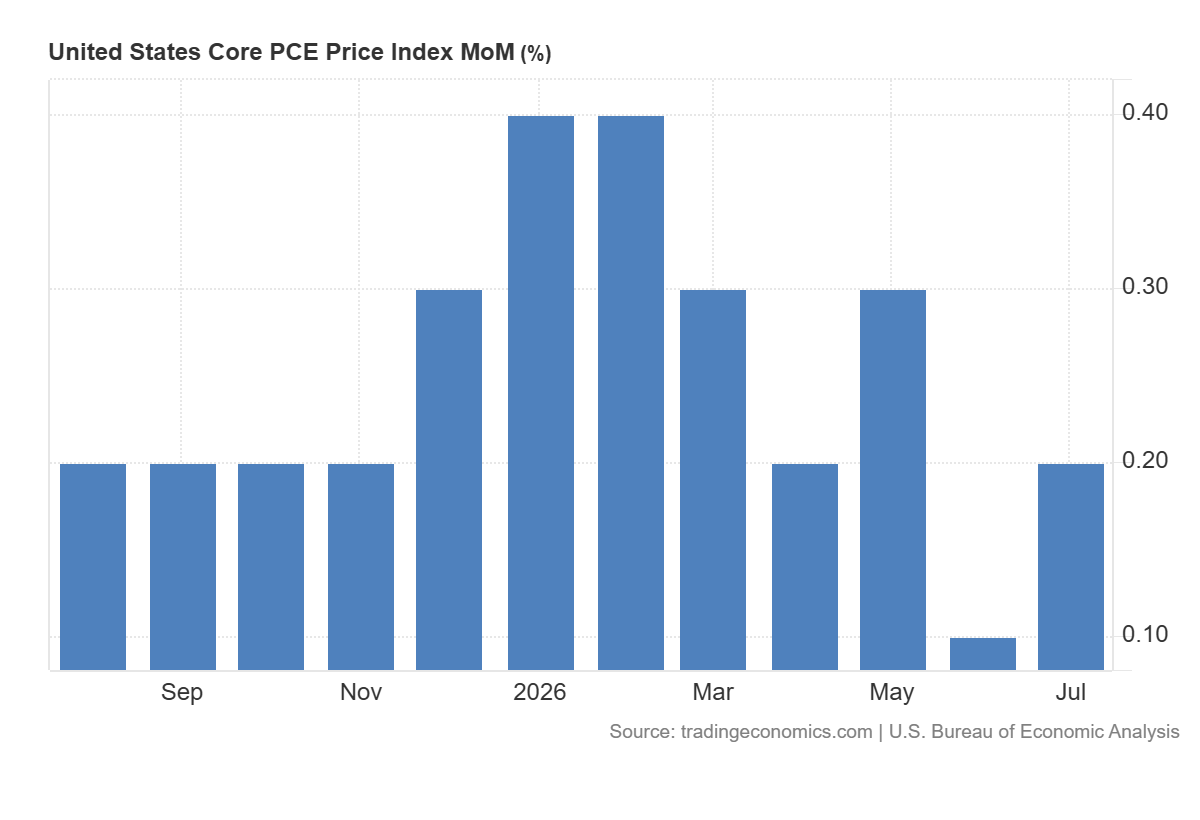
Attention is now focused on the upcoming release of the U.S. Core PCE m/m data, an indicator that measures monthly changes in consumer prices and is widely considered one of the Federal Reserve's most important inflation gauges. The indicator has delivered mixed readings in recent months. July showed a 0.2% increase, above this year's low of 0.1%, while consensus forecasts for this week's release point to a 0.3% increase. If expectations are confirmed, it would suggest that inflation pressures remain present in the U.S. economy. A stronger-than-expected reading could further reinforce the outlook for a more aggressive Fed and increase expectations of additional rate hikes in the months ahead.
Source: TradingEconomics
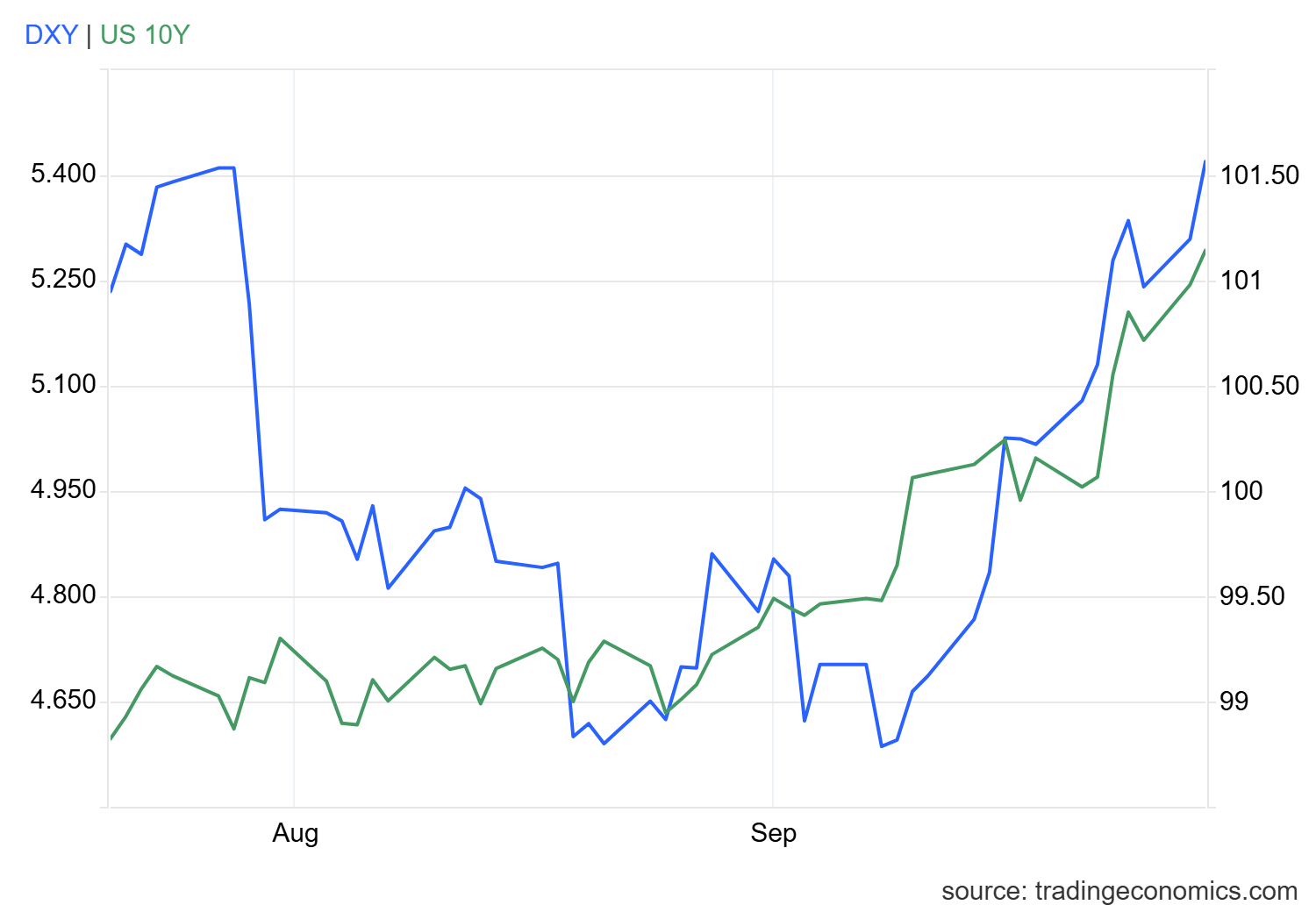
What matters is that these expectations are already benefiting markets that often compete with gold for investor flows. Both the bond market and the U.S. dollar continue to perform well as investors price in higher interest rates. U.S. 10-year Treasury yields have already climbed above 5.2%, reaching new highs for 2026. Meanwhile, the DXY, the index that measures the dollar's strength against its major counterparts, continues to advance above the 101-point level. This combination of higher yields and a stronger dollar has increased the relative attractiveness of these markets compared with gold.
Source: TradingEconomics
Against this backdrop, the continued strength of these alternative markets is limiting gold's ability to attract demand consistently. If expectations for a more aggressive Federal Reserve remain intact even after the PCE release, both Treasury yields and the U.S. dollar may continue to hold onto their recent strength. Under that scenario, gold could continue struggling to regain lost ground, leaving selling pressure around XAU/USD as a key theme in the near term.
Gold Technical Forecast
Source: StoneX, Tradingview
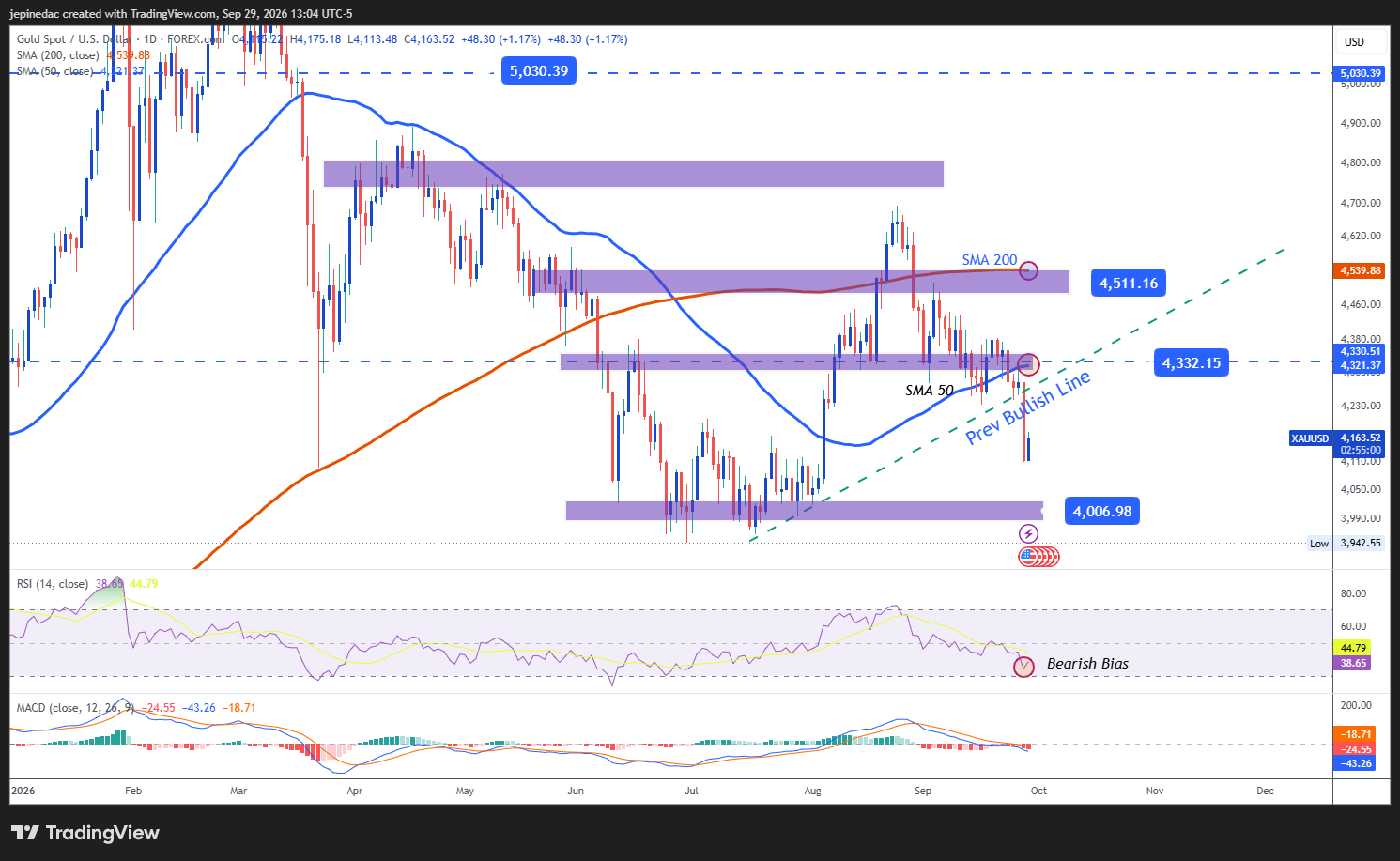
- The bearish move is starting to gain momentum: Although gold had been attempting to maintain a meaningful bullish trend structure over recent weeks, a much more consistent wave of selling pressure has recently emerged. Price action has already broken below several levels associated with that bullish structure and is beginning to shift attention toward a more dominant bearish bias. If this dynamic continues during the coming sessions, it could open the door to a more established downtrend on the chart.
- RSI: The RSI continues to trade below the 50 neutral level, a reading that suggests bearish momentum remains dominant in the short term. As long as this condition persists, downside pressure could continue gaining relevance around gold prices.
- MACD: A similar picture can be seen in the MACD, whose histogram remains below the 0 neutral line. This reading reflects fading bullish momentum within short-term moving averages and supports the idea that the bearish bias continues to strengthen.
Key Levels to Watch:
- $4,500 – Key Resistance: A significant upside barrier that coincides with the most important highs on the chart and partially aligns with the 200-period simple moving average. A move back toward this level could restore a bullish bias and revive the upward structure that had dominated the market in previous weeks.
- $4,330 – Near-Term Barrier: The main equilibrium area on the chart, respected several times during the previous week and now aligned with the 50-period simple moving average. If price returns to this area, a more evident lack of direction could emerge and potentially give way to a broader consolidation phase.
- $4,000 – Critical Support: An important support area that also represents a major psychological level for the market. Sustained moves toward this zone could reinforce the dominance of sellers and open the door to a more established bearish trend in the weeks ahead.
Written by Julian Pineda, CFA, CMT – Market Analyst
Follow him on: @julianpineda25
Related tags:


Open an account today
Experience award-winning platforms with fast and secure execution.
Economic calendar
Web Trader platform
Our sophisticated web-based platform is packed with features.
Related articles

Gold weekly outlook: XAU/USD finally finds support but overhead resistance looms
The gold outlook remains uncertain following year-long selling. While the recent rebound is a welcome sign, this could just turn out to be an oversold bounce.


Gold Outlook: Can XAU/USD Sustain Its Recent Rebound?
The trading week is coming to an end, and gold continues to exhibit a lack of clear direction in the short term. Although the precious metal spent most of the week under pressure, it managed to recover more than 2.3% heading into the close, reclaiming part of its recent losses. Even so, the rebound remains insufficient to sustain consistent moves above the $3,700 per ounce level.

USD/MXN Forecast: Mexican Peso Weakness Persists as Year-End Approaches
These continue to be challenging sessions for the Mexican peso. The currency has remained under pressure in recent weeks, a trend clearly reflected in USD/MXN, which has now posted seven consecutive bullish sessions, gaining more than 7.0% over that period.
From time to time, StoneX Financial Pty Ltd (“we”, “our”) website may contain links to other sites and/or resources provided by third parties. These links and/or resources are provided for your information only and we have no control over the contents of those materials, and in no way endorse their content. Any analysis, opinion, commentary or research-based material on our website is for information and educational purposes only and is not, in any circumstances, intended to be an offer, recommendation or solicitation to buy or sell. You should always seek independent advice as to your suitability to speculate in any related markets and your ability to assume the associated risks, if you are at all unsure. No representation or warranty is made, express or implied, that the materials on our website are complete or accurate. We are not under any obligation to update any such material.
As such, we (and/or our associated companies) will not be responsible or liable for any loss or damage incurred by you or any third party arising out of, or in connection with, any use of the information on our website (other than with regards to any duty or liability that we are unable to limit or exclude by law or under the applicable regulatory system) and any such liability is hereby expressly disclaimed.