



USD/JPY unwind accelerates as GPIF headlines spark yen buying
Japanese assets are rallying after the government floated the prospect of the GPIF investing more heavily at home. While the proposal could have significant implications for global capital flows, it does not yet change the broader forces driving Japanese bond yields and USD/JPY.
Share this:

- GPIF proposal sparks capital repatriation hopes
- Long-dated JGBs lead powerful relief rally
- Imported inflation strengthens BOJ normalisation case
- USD/JPY nears trendline support
Japanese assets rally on GPIF proposal
Japanese assets are rallying after Finance Minister Satsuki Katayama said the government wants to encourage Japan's GPIF, the world's largest pension fund, to invest substantially more domestically.
The reason markets are reacting so strongly is because this isn't just any pension fund. The GPIF manages almost ¥300 trillion, or around US$1.8 trillion. If even a small portion of that portfolio is redirected towards domestic assets, you're potentially talking about a meaningful shift in global capital flows, with money coming back into Japan to buy yen-denominated investments.
Katayama's comments come after a bruising week for Japan's debt markets, with long-dated government bond yields surging to multi-decade highs. At the same time, the yen fell to its weakest levels in decades on a trade-weighted basis, underscoring the broad-based nature of its decline. If the GPIF were to increase its allocation to domestic assets, it could help support both the bond market and yen.
And that's exactly where the market reacted first.
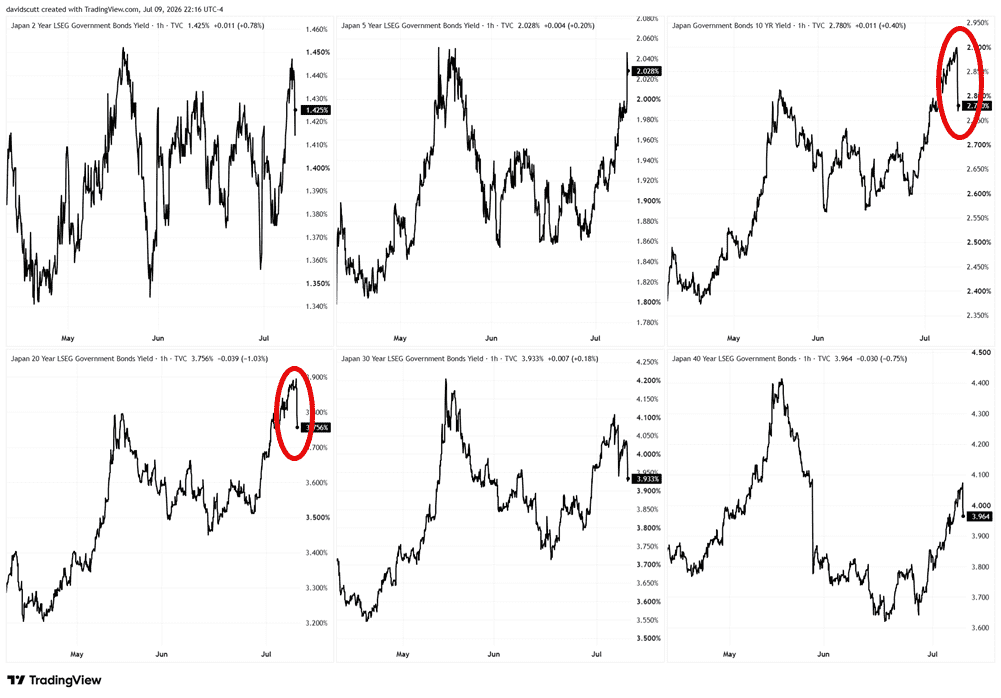
JGB long-end yields tumble
Source: TradingView
Long-dated Japanese government bonds are leading the rally, particularly in the 10 to 20-year sector, which had borne the brunt of this week's sell-off. The subsequent flattening of the curve reflects not only the prospect of stronger domestic demand, but also stronger-than-expected Japanese producer price data. Prices rose 7.1% from a year earlier in June, beating expectations. Import prices within the report also surged 29.7%, reinforcing the inflationary impact of the weaker yen and adding to the case for the Bank of Japan to continue gradually normalising monetary policy.
While today's developments are supportive for Japanese bonds, they don't alter the broader fundamental backdrop. Much of the upward pressure on Japanese yields has reflected global forces, particularly the rise in US real yields. Even after the recent backup in nominal yields, Japanese real yields remain negative, limiting their appeal relative to overseas bond markets. That's why today's GPIF announcement is important, but it doesn't completely offset the broader forces that have been weighing on the market.
Nuance needed for Nikkei 225
Source: TradingView
At first glance, the prospect of the GPIF increasing its allocation to domestic assets looks supportive for Japanese equities. However, there's an important caveat. If the announcement is accompanied by a sustained appreciation in the yen, it could create headwinds for Japan's export-oriented companies, tempering some of the positive impact from stronger domestic institutional demand.
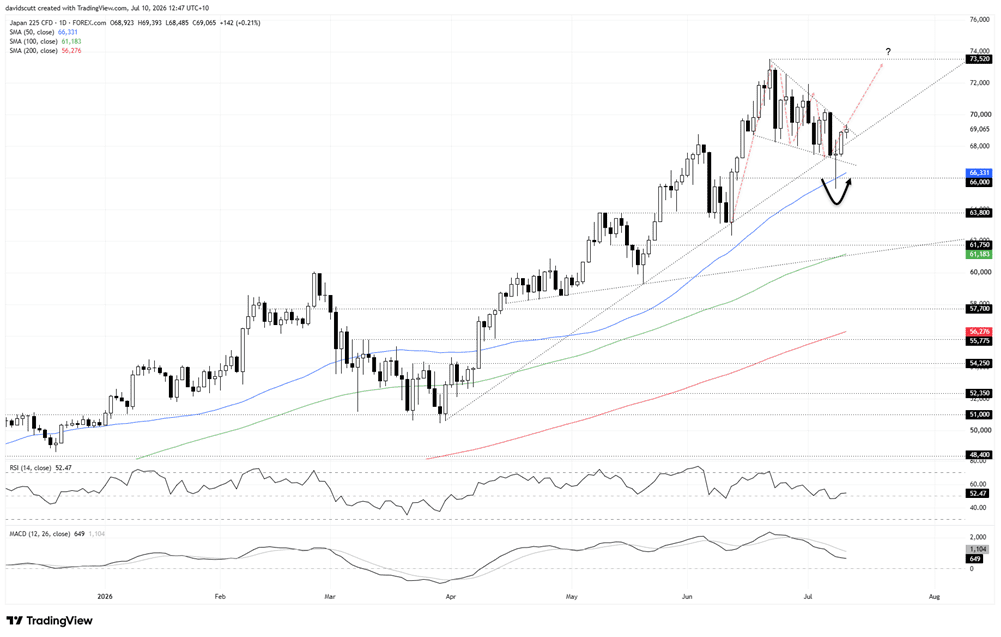
Looking at the chart, the Nikkei continues to coil within what appears to be a falling wedge, a bullish continuation pattern that points to the potential for an upside breakout.
Earlier this week, the index completed a dragonfly doji after a false break beneath wedge support before rebounding strongly from the intersection of the 50-day moving average with 66,000, the latter a level that acted as both support and resistance in June. That failed breakdown leaves the focus on the topside.
A break above wedge resistance would strengthen the bullish case, bringing a retest of the record high at 73,520 into view. On the way, 72,000 may provide resistance, having capped gains on two occasions in June.
The oscillators paint a more neutral picture. RSI is sitting around the 50 level after posting a series of lower highs, while MACD remains in positive territory but has flattened noticeably. Together, they suggest upside momentum has moderated, although not sufficiently to undermine the broader bullish technical setup.
USD/JPY unwind gathers pace
Source: TradingView
The final leg of the story is the yen. If Japanese institutions begin reallocating capital back home, that naturally creates demand for the currency, helping explain why USD/JPY has pulled back from this week's highs.
Positioning may also be amplifying the move. Speculative investors are already carrying one of the largest net short yen positions in more than a decade, according to the latest Commitment of Traders data. That leaves the market vulnerable to bouts of short covering whenever positive yen catalysts emerge.
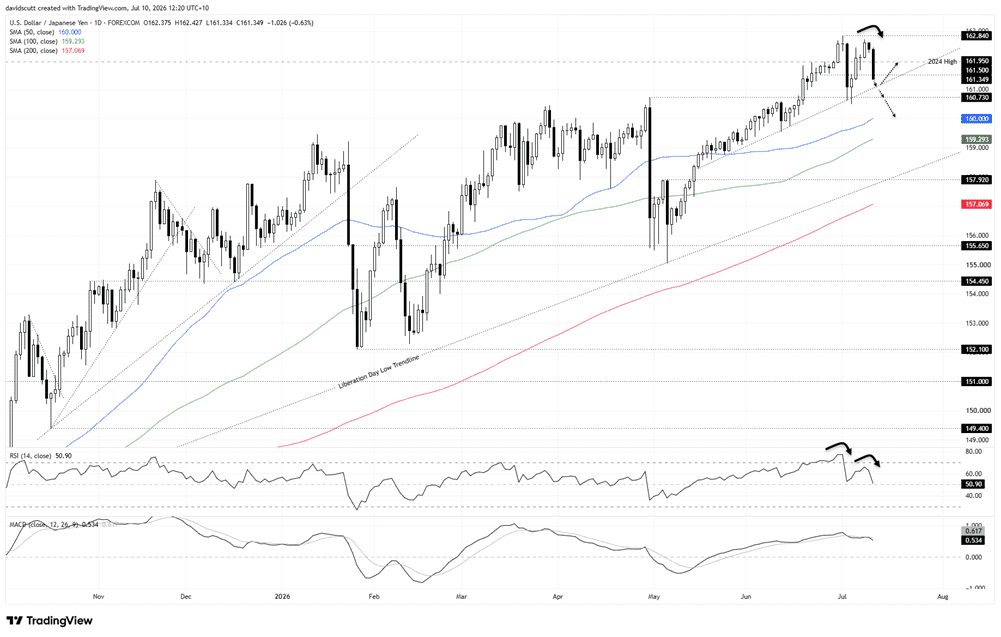
Looking at the chart, USD/JPY has slipped beneath not only the 2024 high at 161.95, but also 161.50, a level that acted as both resistance and support earlier this year. The pair is now approaching uptrend support dating back to the middle of May, which comes in around 161 today.
A break below would expose 160.73, the former 2026 high set in late April and successfully defended on two occasions in early July, making it an important support zone to watch. A move below that area, and particularly beneath 160.50, would open the door for a test of the 50-day moving average, located around 160.
Momentum indicators are also beginning to soften. RSI has rolled over after posting a series of lower highs and is now back around the neutral 50 level. MACD has produced a bearish crossover while remaining in positive territory, suggesting upside momentum is not only fading but could be on the cusp of shifting in favour of the bears.


Open an account today
Experience award-winning platforms with fast and secure execution.
Economic calendar
Web Trader platform
Our sophisticated web-based platform is packed with features.
Related articles

Nasdaq 100 forecast: Stocks rebound, but have markets found a floor?
US equities have recovered sharply after last week’s bruising sell-off, as confidence in Nvidia draws investors back into technology stocks. But a busy economic calendar, led by the November jobs report, will test whether the rebound has legs.


EUR/USD Recovers as Markets Fully Price in Fed Hike
EUR/USD outlook turns on Fed pricing, as the euro recovers while strong U.S. data fails to lift a dollar that has already priced in Fed tightening.

Silver Outlook: Improving risk appetite puts squeeze in play
Silver continues to amplify moves in gold, with unusually strong correlations with tech stocks offering another reason to monitor the recovery in risk appetite.
From time to time, StoneX Financial Pty Ltd (“we”, “our”) website may contain links to other sites and/or resources provided by third parties. These links and/or resources are provided for your information only and we have no control over the contents of those materials, and in no way endorse their content. Any analysis, opinion, commentary or research-based material on our website is for information and educational purposes only and is not, in any circumstances, intended to be an offer, recommendation or solicitation to buy or sell. You should always seek independent advice as to your suitability to speculate in any related markets and your ability to assume the associated risks, if you are at all unsure. No representation or warranty is made, express or implied, that the materials on our website are complete or accurate. We are not under any obligation to update any such material.
As such, we (and/or our associated companies) will not be responsible or liable for any loss or damage incurred by you or any third party arising out of, or in connection with, any use of the information on our website (other than with regards to any duty or liability that we are unable to limit or exclude by law or under the applicable regulatory system) and any such liability is hereby expressly disclaimed.