



USD/CAD Analysis: Can the Canadian Dollar Maintain Its Momentum?
The trading week continues to be particularly relevant for the strength currently being displayed by the Canadian dollar. Over the last two trading sessions, USD/CAD has declined by approximately 0.7%, once again highlighting a bearish bias in favor of the Canadian currency.
Share this:

The trading week continues to be particularly relevant for the strength currently being displayed by the Canadian dollar. Over the last two trading sessions, USD/CAD has declined by approximately 0.7%, once again highlighting a bearish bias in favor of the Canadian currency. This selling pressure has remained in place following the latest announcements from the Bank of Canada, which have started to shift monetary policy expectations, while also reflecting a recent loss of momentum in the U.S. dollar. As long as these catalysts remain relevant, downside pressure around USD/CAD could continue to play an important role during the coming trading sessions.

What Happened at the Bank of Canada Meeting?
Yesterday's session featured the latest interest rate decision from the Bank of Canada. On this occasion, policymakers decided to leave rates unchanged at 2.25%, marking the seventh consecutive meeting without a change in interest rates.
While the decision itself was widely anticipated, the tone adopted during the press conference proved more interesting. The central bank appeared increasingly cautious regarding inflation and highlighted that upside inflation risks have started to build. Part of this concern stems from higher oil prices driven by tensions in the Middle East, as well as pressures associated with the trade environment between Canada and the United States.
In fact, the institution emphasized that inflation continues to hover around the 3.00% area, driven primarily by rising gasoline prices. This reinforces the idea that the energy component could continue transmitting inflationary pressures to the broader economy.
The central bank's concerns remain relevant because there have not yet been meaningful declines in Canada's annual inflation rate. Based on the latest data available for July, inflation remains close to 3.00%, once again approaching this year's highs near 3.2%. This suggests that price pressures are not slowing quickly enough to move consistently back toward the 2.00% target, a situation that may help explain the more concerned tone adopted by policymakers.
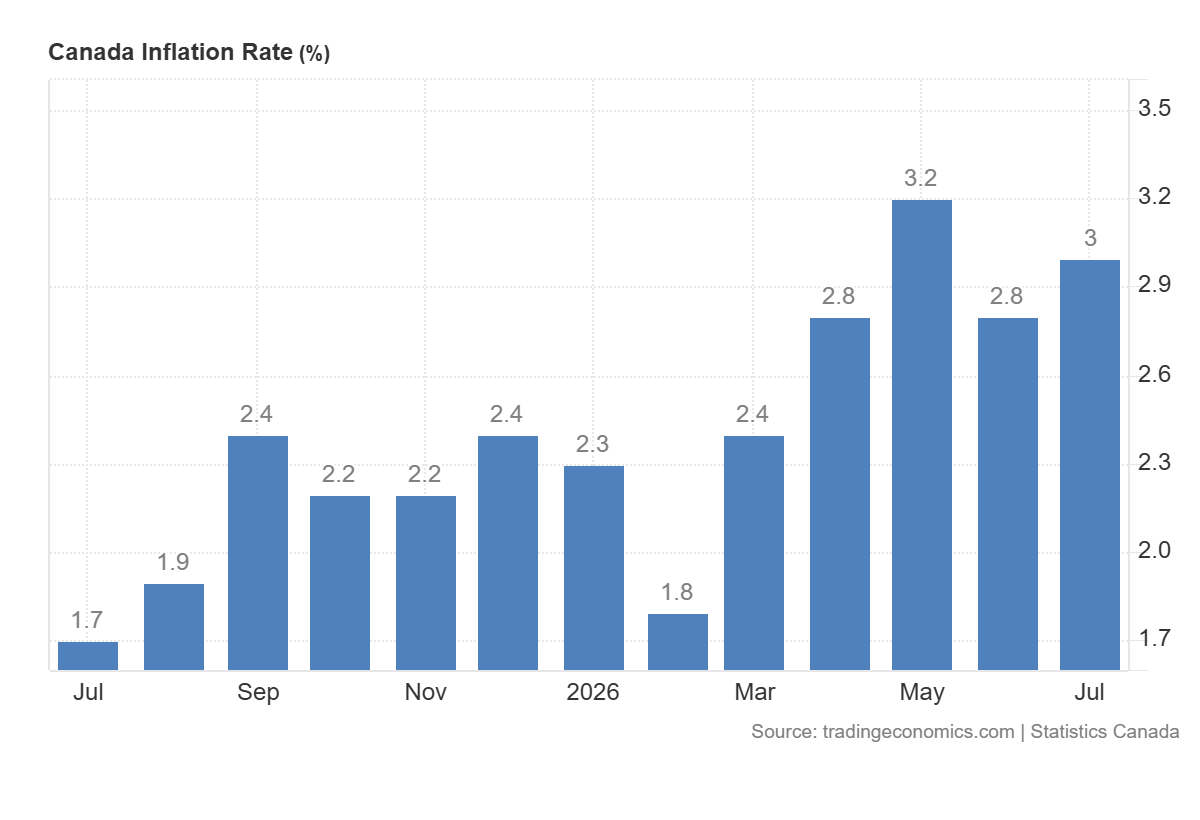
Source: TradingEconomics
As a result, markets have started pricing in the possibility of a future rate hike. In fact, some expectations models now show probabilities above 40% that the Bank of Canada could increase rates at its late-October meeting above the current 2.25% level.
This development is particularly important because the comments delivered yesterday had not been seen with this level of intensity in recent months and suggest a gradual shift toward a more restrictive policy stance.
Consequently, the decision has been supportive of the Canadian dollar. The prospect of higher interest rates could improve the attractiveness of Canadian dollar-denominated investments and help reinforce demand for the currency. As long as markets continue perceiving a more hawkish central bank, this dynamic could continue to favor downside pressure in USD/CAD over the coming weeks.
Is the U.S. Dollar Beginning to Lose Ground?
Another important factor is the recent loss of momentum in the U.S. dollar. As the release of the NFP employment report approaches, markets have once again begun questioning the direction the Federal Reserve could take in upcoming policy decisions.
Part of this uncertainty emerged after the ADP Non-Farm Employment Change report showed the creation of 38,000 jobs, below the 47,000 expected by the market. This reading started to raise doubts about whether the Federal Reserve needs to adopt a more aggressive stance in the months ahead.
Indeed, probabilities published by CME Group have begun to reflect this shift. Just one session ago, markets assigned roughly a 36% probability that rates would remain at the 3.75% level during the September 16 meeting. That probability has now risen to around 51%, highlighting growing uncertainty surrounding upcoming economic data and how it may influence future Federal Reserve decisions.
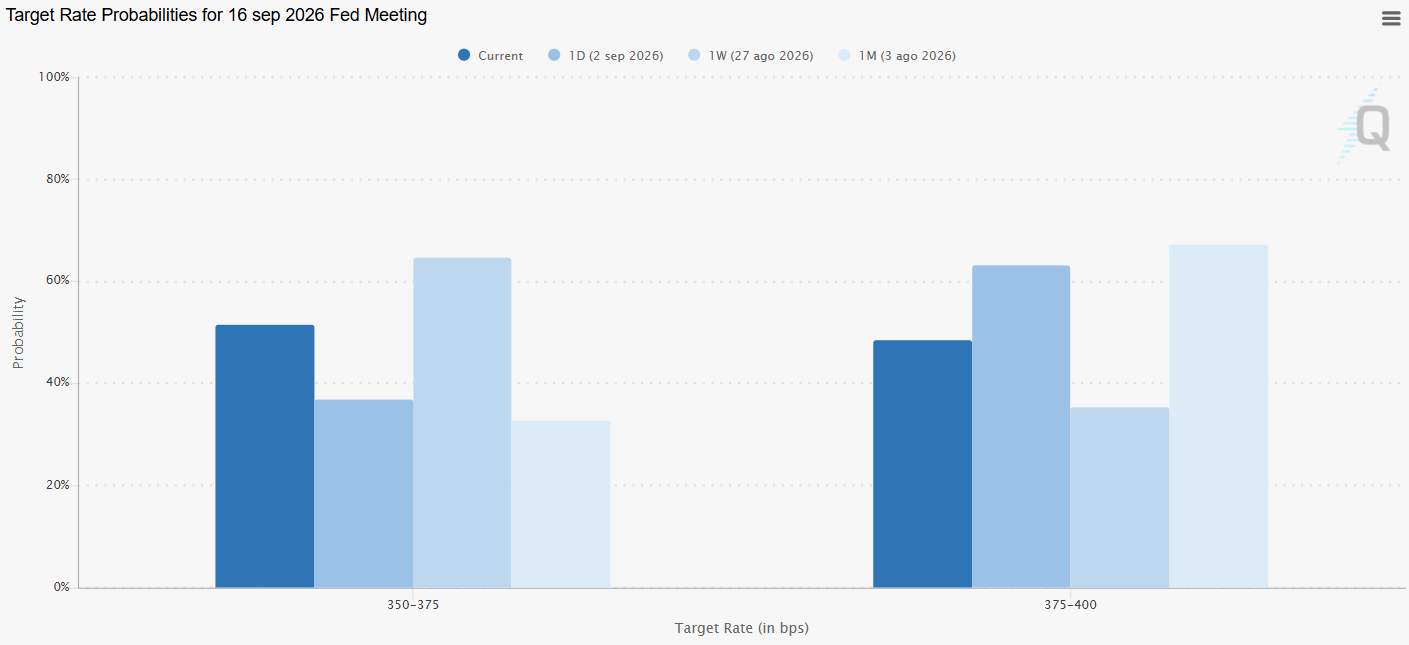
Source: CMEGROUP
This situation is relevant for the recent loss of strength in the U.S. dollar because reduced expectations of a more aggressive Federal Reserve can diminish part of the appeal of USD-denominated investments. As a result, this environment may be helping the Canadian dollar regain ground more consistently.
For that reason, if the upcoming NFP data continues to reinforce the perception of a softer-than-expected economy, selling pressure around USD/CAD could remain relevant over the next few weeks.
USD/CAD Technical Outlook
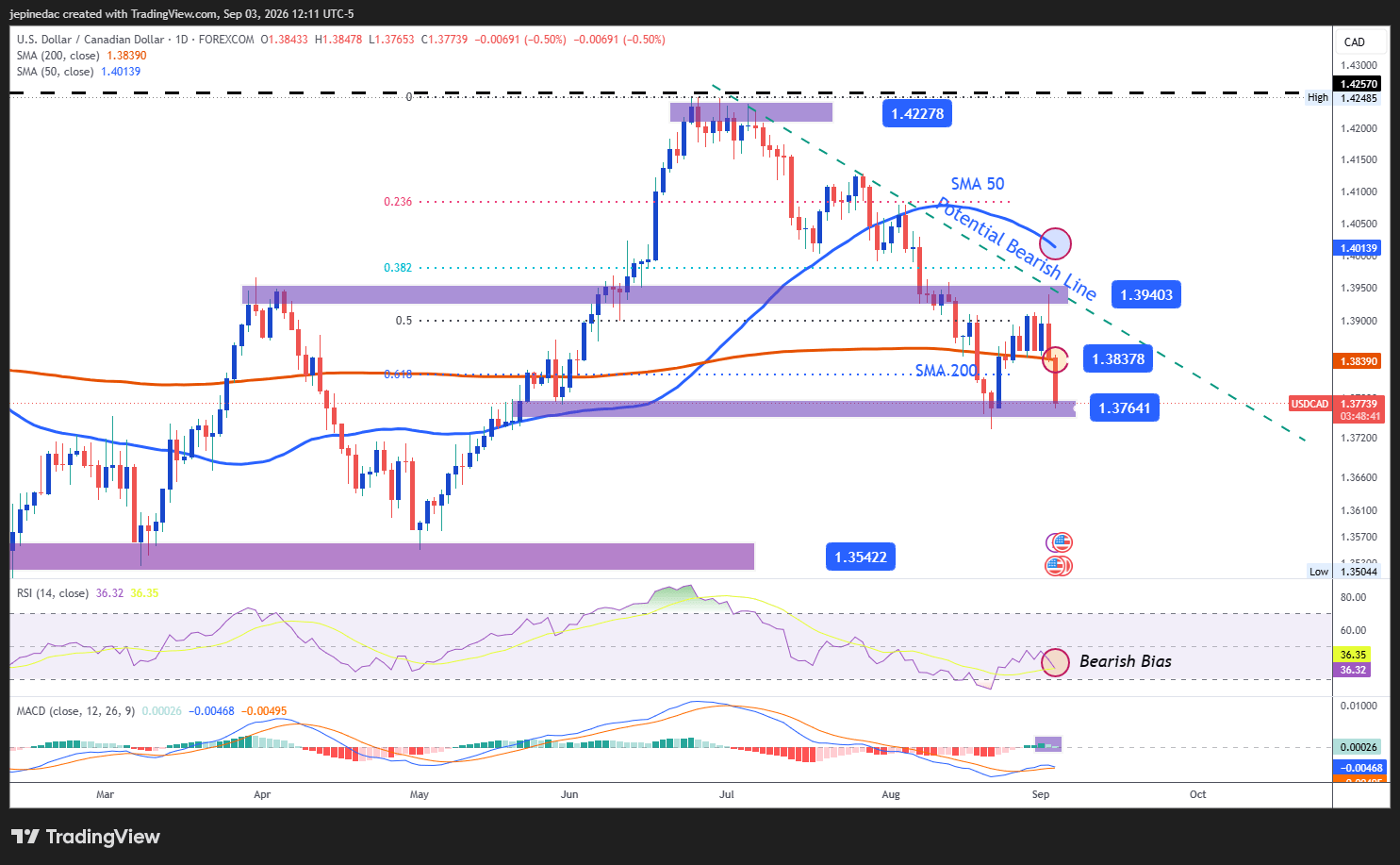
Source: StoneX, Tradingview
- Potential Downtrend Begins to Regain Relevance: Price action over recent weeks has started to shape a potential bearish trendline on the chart. Following the latest decline, this structure has become more relevant and, as long as selling pressure continues to dominate, it could eventually consolidate as the primary technical pattern to monitor in the weeks ahead.
- RSI: The indicator continues to trade below the neutral 50 level, signaling that bearish momentum remains relevant within the market. If this behavior persists, the bearish bias could continue playing an important role in USD/CAD price action.
- MACD: The MACD presents a slightly different reading, as its histogram continues to fluctuate very close to the neutral 0 line. This suggests that some balance still remains within short-term moving average strength and indicates that the possibility of corrective bullish moves has not completely disappeared from the chart.
Key Levels:
- 1.39403 – Key Resistance: A recent equilibrium zone that also coincides with the medium-term bearish trendline. Sustained price action above this area could put the dominant bearish structure at risk and create room for a more relevant bullish bias to emerge over the coming weeks.
- 1.38378 – Nearby Barrier: This level coincides with the 200-period Simple Moving Average and is located near the 61.8% Fibonacci retracement. It could become the key technical reference to monitor should corrective bullish moves start developing in the sessions ahead.
- 1.37641 – Critical Support: This area corresponds to recent lows and remains the most important downside barrier on the chart. A sustained break below this level would reinforce bearish control and could open the door to a broader extension of the downtrend over the coming weeks.
Written by Julian Pineda, CFA, CMT – Market Analyst
Follow him on: @julianpineda25



Open an account today
Experience award-winning platforms with fast and secure execution.
Economic calendar
Web Trader platform
Our sophisticated web-based platform is packed with features.
Related articles

Gold Outlook: Can XAU/USD Sustain Its Recent Rebound?
The trading week is coming to an end, and gold continues to exhibit a lack of clear direction in the short term. Although the precious metal spent most of the week under pressure, it managed to recover more than 2.3% heading into the close, reclaiming part of its recent losses. Even so, the rebound remains insufficient to sustain consistent moves above the $3,700 per ounce level.

EUR/USD Recovers as Markets Fully Price in Fed Hike
EUR/USD outlook turns on Fed pricing, as the euro recovers while strong U.S. data fails to lift a dollar that has already priced in Fed tightening.

Silver Outlook: Improving risk appetite puts squeeze in play
Silver continues to amplify moves in gold, with unusually strong correlations with tech stocks offering another reason to monitor the recovery in risk appetite.

From time to time, StoneX Financial Pty Ltd (“we”, “our”) website may contain links to other sites and/or resources provided by third parties. These links and/or resources are provided for your information only and we have no control over the contents of those materials, and in no way endorse their content. Any analysis, opinion, commentary or research-based material on our website is for information and educational purposes only and is not, in any circumstances, intended to be an offer, recommendation or solicitation to buy or sell. You should always seek independent advice as to your suitability to speculate in any related markets and your ability to assume the associated risks, if you are at all unsure. No representation or warranty is made, express or implied, that the materials on our website are complete or accurate. We are not under any obligation to update any such material.
As such, we (and/or our associated companies) will not be responsible or liable for any loss or damage incurred by you or any third party arising out of, or in connection with, any use of the information on our website (other than with regards to any duty or liability that we are unable to limit or exclude by law or under the applicable regulatory system) and any such liability is hereby expressly disclaimed.