
FAQs
Get help with your trading account or browse answers on specific markets and products.
Popular FAQs
Account forms
About FOREX.com
FOREX.com VIP
Cash Rebates
CFDs
Charting Tools
Commodities
Demo Accounts
Forex Trading
FOREX.com Desktop Platform
FOREX.com Mobile Trading Apps
FOREX.com Web Trader Platform
Funding
Indices
Limit up/limit down
24-Hour CFD Equity Trading
Liquidation
Margin & Leverage
Market Analysis
Metals
MetaTrader
Opening an Account
Orders & Execution
Passwords and Account Settings
Performance Analytics
Pricing and Fees
RAW Pricing Account
Rollover
Security
Stocks
Trading Halts
TradingView
Withdrawals
Commodities Trading FAQs
Browse this FAQ section for more information about commodities trading.
With FOREX.com, you can trade crude oil, natural gas, corn and more as CFDs. View our range of markets.
A CFD, or contract for difference, is an agreement to exchange the difference between the opening and closing price of the position under contract, rather than buying and selling the underlying security outright.
FOREX.com is compensated by the spread, which is the difference between the bid and ask prices. View our live spreads.
In addition, you may be charged a nightly finance charge if you hold a position overnight, after 5pm ET.
With most CFDs, financing is debited for long positions or credited for short positions daily if you are in a position at 5pm ET.
These charges are typically calculated as follows:
F=(S x P x R)/D
F - Daily Financing Charge
S - Number of CFDs (2500)
P - Closing Price
R - Relevant interest rate benchmark, +250 basis points for long positions or -250 basis points for short positions, e.g. (4.50% + 3.00%) = 7.50%
D - Number of days, i.e. 365 for UK stocks and 360 for all others
FOREX.com offers two types of CFDs: Futures CFDs, which are dated for a specific contract month and expire automatically at the end of their contract period, and Cash CFDs, which do not expire. Visit How are Non-Expiring Commodities (NEC) priced? for more information on Cash Commodity CFDs. Note that only Futures CFDs are available on the MetaTrader 4 platform. Standard expiry definitions are available in the table below. To see the exact Last Dealing Time for each market, check the Market 360 tab on the for each market on the FOREX.com Web Trading platform, or the under the Company tab in the Terminal window of MetaTrader 4.
If you don't close a Futures CFD position before the Last Dealing Time, it will be closed automatically once the applicable closing price has been determined, and any open orders will be cancelled. The closing price will be determined by reference to the underlying futures market and may be the official settlement price, the last traded price, or another value reported by the relevant exchange on the day of expiry, as applicable. Alternatively, you can tick Autoroll, which will roll your Futures position to the next contract month prior to expiry. Please note that Autoroll closes the expiring contract and realizes any profit or loss before opening a new position in the next contract month. For MetaTrader 4 accounts, to keep your exposure, you must manually open a new position in the next contract month after expiry, as MetaTrader does not support the Autoroll function.
To price these non-expiring markets, we use two sufficiently liquid futures contracts on the underlying commodity. This is usually the two with the nearest expiry date.
The contract with the closest expiry date is called the Front month contract and the second-nearest expiry date is called the Far month contract.
Throughout the duration of the Front month contract, the price of the NEC will gradually move from the price of the front month to the price of the far month.
As there will be an adjustment to the NEC Market price every day, your account will be subject to an adjustment in the form of a Credit/Debit to offset this price adjustment. For example, if the NEC contract is adjusted by +2 points, clients with long positions will be debited 2 x stake and clients with short positions will be credited 2 x stake. See further explanation and video below.
In our video, the front month is labelled ‘A’ and the far month ‘B’.
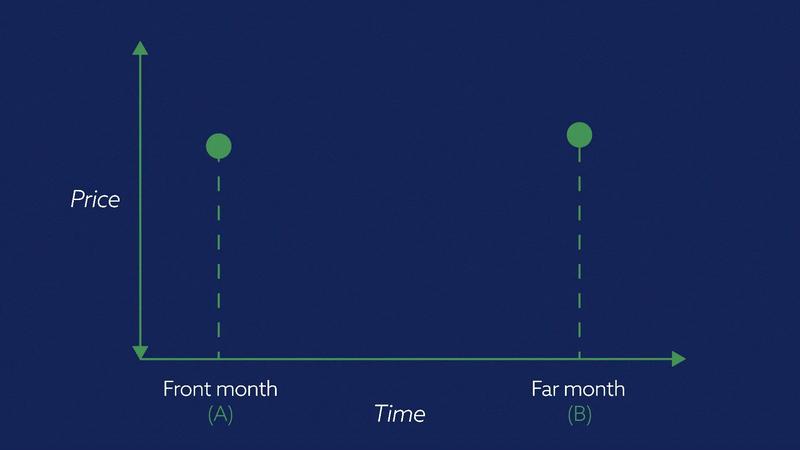
NEC contract market prices move from the price of market ‘A’ towards the price of market ‘B’ as the expiry date of ‘A’ becomes closer. The price of market ‘B’ may be higher or lower, depending on the commodity, than that of market ‘A’.
Daily adjustments for NEC contract markets reflect a day’s movement from ‘A’ towards ‘B’.
In addition, a cost of carry will be applied to represent the NEC as a cash asset.
This will be observed as a movement up daily (inc. weekends) during the close period of Underlying Ccy Overnight Rate * Last Price / 365. This reflects the cost of carry being paid by longs and received by shorts. This is, in essence, the cost of rolling to a new value date and explained in more detail below.
E.g. In US Crude with the price at $7800 and an USD overnight rate of 5.3%, this adjustment is 1.1 pips daily.
Cost of Carry Logic
A client can either buy an asset now and pay to borrow the cash for a day, or they can buy it tomorrow and pay one day’s less interest. Put another way, someone with $1000 can either buy $1000 of an asset today or receive one day's interest XX on that $1000 and buy $1000.XX of that asset tomorrow.
Both outcomes must be equal; this is the cash-futures parity. Otherwise, there is an arb, and everyone buys today and not tomorrow, or vice versa.
This is observed in Indices, where (ignoring dividends) the cash price moves up towards the future daily as the cost of carry to expiry reduces. We are applying this same logic to Cash Commodities.
Margins for commodities vary according to the market and type of account.
For more information on a specific market, please check the Key Market Information or Market 360 within the trading platform, or explore our margin requirements page.
The formula to calculate how much margin is required is quantity x price x margin.
Changes Affecting Oil Trades:
Scenario | Change |
|---|---|
Oil price drops below $5.00 | In the event the price of any of our oil contracts drops below $5.00/barrel, trading restrictions may then apply as follows: |
Oil price reaches zero | In the event the price of any our oil contracts reaches or falls below zero, we will close any long or short positions on that market at the current available market price. |
Markets affected:
Platform | Market(s) |
|---|---|
Web Trader | US Crude Oil (all contracts) |
MT4 | WTI/USD |
MT5 | US Crude Oil (all contracts) |
Futures CFDs are priced using a single specific futures contract month (for example, the Front month contract).
Non-Expiring Commodities (NEC) are priced using two sufficiently liquid futures contracts — the Front month and the Far month — with the price gradually transitioning from the Front month towards the Far month.
Different futures contract months trade at different prices due to variations in supply and demand. As a result, the price of an NEC market may be higher or lower than the nearest liquid futures contract, depending on how prices move toward the Far month contract.
Futures contract months may trade at higher or lower prices depending on prevailing market conditions.
When the Far month contract is priced higher than the Front month contract, this is known as contango.
When the Far month contract is priced lower than the Front month contract, this is known as backwardation.
These price differences reflect factors such as interest rates, supply and demand dynamics, storage costs, and the time remaining until contract expiry.
The table below outlines the contract size for each commodity trade, along with key contract specifications such as tick size, tick value, and contract equivalency.
Market | Tick Size | Tick Value | Contract Equivalent |
|---|---|---|---|
Corn | 0.25 | $0.25 | 400 bushels |
Soybean | 0.25 | $0.25 | 400 bushels |
Wheat | 0.25 | $0.25 | 400 bushels |
Cotton No. 2 | 0.01 | $0.01 | 10,000 lbs |
Sugar No. 11 | 0.01 | $0.01 | 10,000 lbs |
Natural Gas | 0.001 | $0.001 | 1,000 MMBtu |
US Crude Oil | 0.01 | $0.01 | 100 barrels |
Heating Oil | 1 | $1.00 | 10,000 US Gallons |
UK Crude Oil | 1 | $1.00 | 100 barrels |
Copper | 0.05 | $0.05 | 2,000 lbs |
Palladium | 0.1 | $0.10 | 10 troy oz. |
Platinum | 0.1 | $0.10 | 10 troy oz. |