



With US Dollar ‘Rebound’ Waning, EUR/USD and GBP/USD Could Bounce
The US dollar’s rebound shows signs of exhaustion, opening the door for EUR/USD and GBP/USD to recover ahead of key US inflation and jobs data.
Share this:

The US dollar’s rebound appears to be running out of steam, raising the prospect of a recovery in EUR/USD and GBP/USD ahead of key US data releases. With inflation figures still due despite the government shutdown and jobless claims on schedule, weaker-than-expected readings could quickly undermine the greenback and reignite bullish momentum in the euro and British pound.
View related analysis:
View related analysis:
US Dollar Weakness Could Lift EUR/USD and GBP/USD
On Monday, I outlined my bias for the US Dollar Index to rebound against last week’s sell-off, which I expected would pressure EUR/USD and GBP/USD lower in the near term. I also noted that any retracements in the euro and British pound could be limited before both currencies resume their upward trends. I believe we’re now entering that phase of the outlook, so today I’ll update my key levels.
Keep in mind that US inflation data is still scheduled for release tomorrow despite the ongoing government shutdown. The weekly jobless claims report will also be published today and remains one of the few data sets continuing on schedule. Weakness in either release could quickly feed back into a softer US dollar on renewed bets of Fed rate cuts.
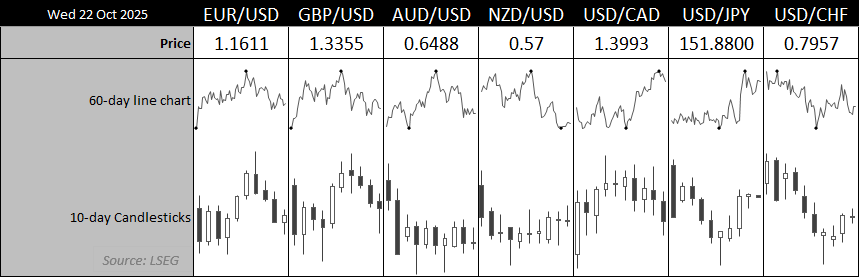
Chart prepared by Matt Simpson – source: LSEG


US Dollar Index (DXY) Technical Analysis
It has been a decent start to the week for the US dollar, having staged a three-day countertrend rally from its 50-day EMA. However, if there’s one thing missing from this rebound, it’s conviction — both volume and bullish volatility are lacking. Daily trading volume has not only been trending lower for nearly two weeks but is now running at roughly half its 20-day average.
Given that this decline in volume coincides with the dollar’s bounce, it suggests the move so far is corrective. Also note the doji that formed on Wednesday, indicating a loss of bullish momentum — hence, I’m now on guard for a potential swing high.
- The weekly R1 sits near the 99 handle, which could attract sellers if the dollar initially pushes higher.
- The weekly pivot at 99.41 serves as a near-term downside target; a break below it would bring the 50-day EMA and high-volume node (HVN) at 97.63 into focus.
- A move above the 99.28 high and 200-day EMA would invalidate the near-term bearish bias.

Chart analysis by Matt Simpson - data source: TradingView
EUR/USD Technical Analysis: Euro vs US Dollar
The euro declined for a third consecutive session against the US dollar, taking EUR/USD back to its monthly S1 pivot point near 1.1588. A small doji candle formed on Wednesday around this key support level, suggesting that bearish momentum may be fading. Also note that the weekly S1 pivot aligns with prior cycle lows, offering further potential support should we see another bout of volatility before a rebound.
If my assumption of a developing swing high in the US Dollar Index (DXY) proves correct, EUR/USD could now stage a recovery. The 50-day EMA (1.1664) represents a logical interim upside target for bulls over the near term, while a sustained break above that level would bring the weekly R1 pivot, monthly pivot, and the 1.1780 high into focus.
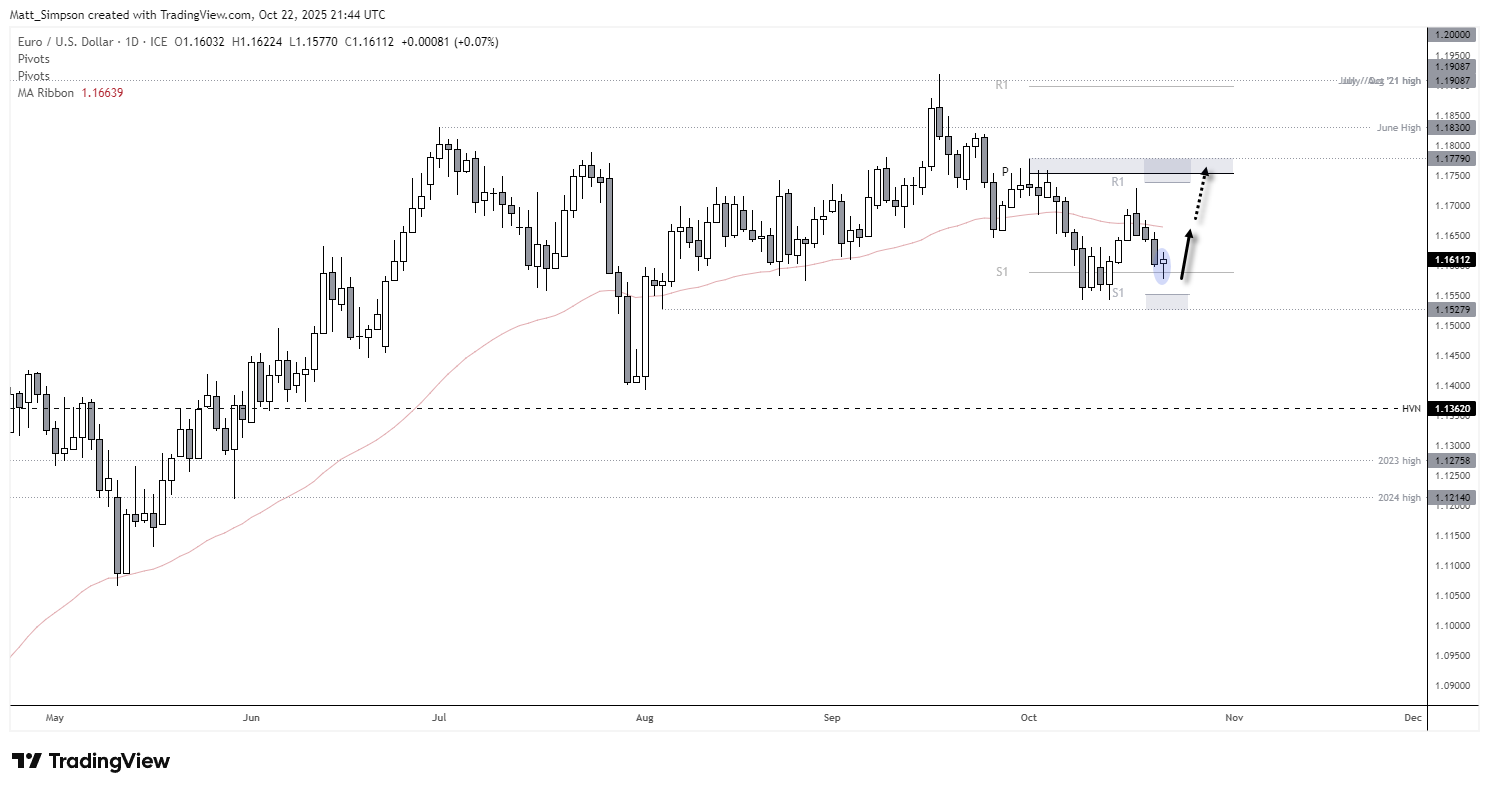
Chart analysis by Matt Simpson - data source: TradingView EUR/USD


GBP/USD Technical Analysis: British Pound vs US Dollar
The bounce from the 200-day EMA worked well — eventually. GBP/USD showed intent to rally from this key moving average a week last Friday, but it wasn’t until last Tuesday’s bullish hammer that we saw the real bounce materialise. The pair reached my upper target near the October VPOC, and since then, my near-term bearish bias has played out nicely this week.
Given Wednesday’s bullish hammer and the fact we’ve now seen four consecutive bearish sessions, I’ve shifted back to a near-term bullish bias. Note that the weekly S1 pivot sits just above the 200-day EMA and the 1.3278 support level, should momentum dip lower once more.
- Overall, bulls may look to buy dips towards Wednesday’s low and maintain a bullish bias while prices remain above the 200-day EMA (1.3274).
- 1.35 could be the next target for bulls, near the monthly pivot point and September VPOC.
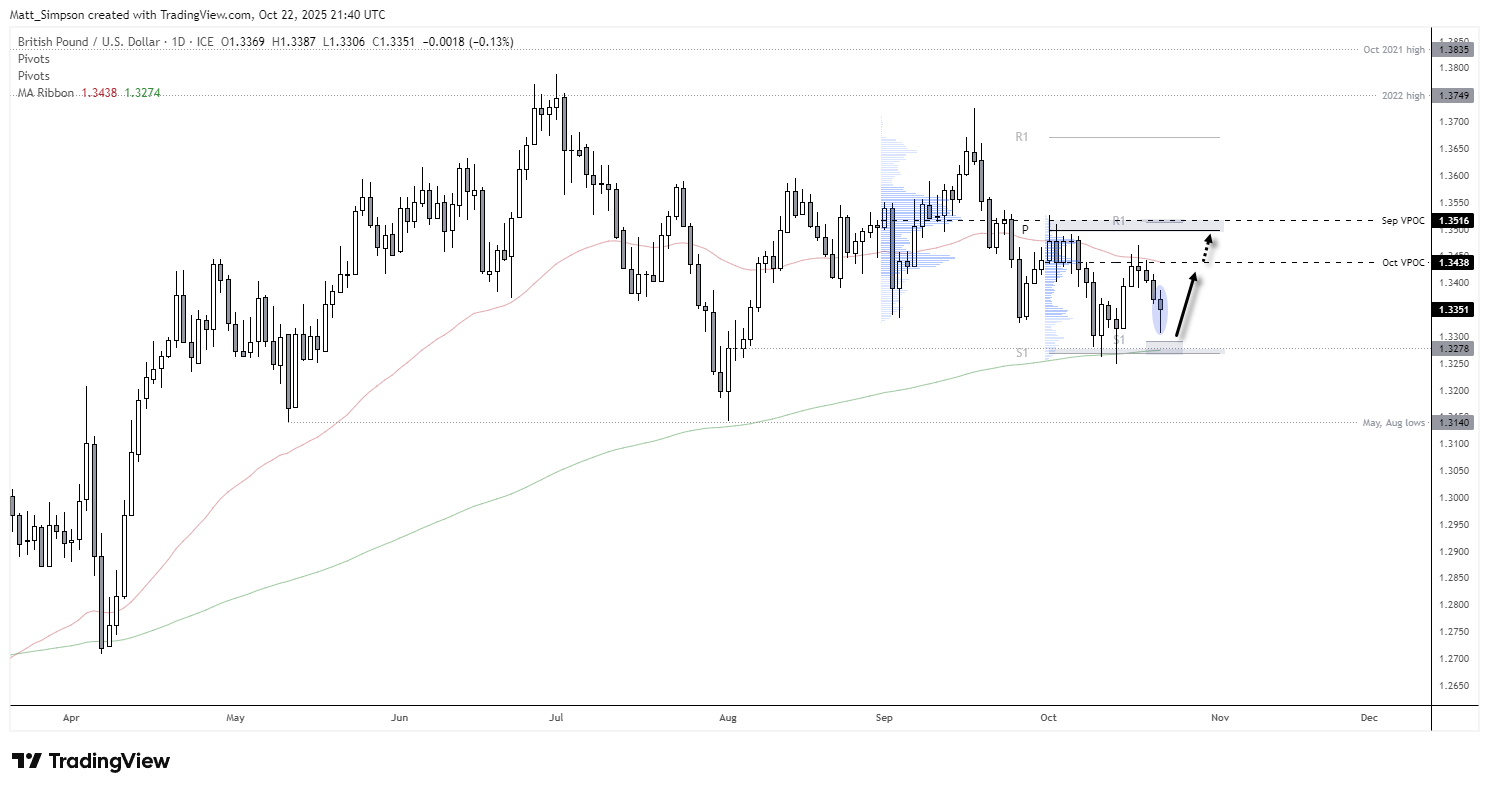
Chart analysis by Matt Simpson - data source: TradingView GBP/USD
View the full economic calendar
View the full economic calendar
-- Written by Matt Simpson
Follow Matt on Twitter @cLeverEdge
How to trade with City Index
You can trade with City Index by following these four easy steps:
- Open an account, or log in if you’re already a customer
• Open an account in the UK
• Open an account in Australia
• Open an account in Singapore
- Search for the market you want to trade in our award-winning platform
- Choose your position and size, and your stop and limit levels
- Place the trade
Related tags:


Open an account in minutes
Experience award-winning platforms with fast and secure execution.
Economic calendar
Web Trader platform
Our sophisticated web-based platform is packed with features.
Related articles

Gold weekly outlook: XAU/USD finally finds support but overhead resistance looms
The gold outlook remains uncertain following year-long selling. While the recent rebound is a welcome sign, this could just turn out to be an oversold bounce.


Nasdaq 100 forecast: Stocks rebound, but have markets found a floor?
US equities have recovered sharply after last week’s bruising sell-off, as confidence in Nvidia draws investors back into technology stocks. But a busy economic calendar, led by the November jobs report, will test whether the rebound has legs.

US dollar outlook: Fed hike priced | FOREX Friday
A December Fed rate hike looks fully priced in, as the dollar stays below this week's highs despite strong US data, while gold, silver and the EUR/USD rebound. Fawad Razaqzada explains why next week's jobs report is the main event, and the Dollar Index levels to watch.
The information on this web site is not targeted at the general public of any particular country. It is not intended for distribution to residents in any country where such distribution or use would contravene any local law or regulatory requirement. The information and opinions in this report are for general information use only and are not intended as an offer or solicitation with respect to the purchase or sale of any currency or CFD contract. All opinions and information contained in this report are subject to change without notice. This report has been prepared without regard to the specific investment objectives, financial situation and needs of any particular recipient. Any references to historical price movements or levels is informational based on our analysis and we do not represent or warranty that any such movements or levels are likely to reoccur in the future. While the information contained herein was obtained from sources believed to be reliable, author does not guarantee its accuracy or completeness, nor does author assume any liability for any direct, indirect or consequential loss that may result from the reliance by any person upon any such information or opinions.
Futures, Options on Futures, Foreign Exchange and other leveraged products involves significant risk of loss and is not suitable for all investors. Losses can exceed your deposits. Increasing leverage increases risk. Spot Gold and Silver contracts are not subject to regulation under the U.S. Commodity Exchange Act. Contracts for Difference (CFDs) are not available for US residents. Before deciding to trade forex, commodity futures, or digital assets, you should carefully consider your financial objectives, level of experience and risk appetite. Any opinions, news, research, analyses, prices or other information contained herein is intended as general information about the subject matter covered and is provided with the understanding that we do not provide any investment, legal, or tax advice. You should consult with appropriate counsel or other advisors on all investment, legal, or tax matters. References to FOREX.com or GAIN Capital refer to StoneX Group Inc. and its subsidiaries. Please read Characteristics and Risks of Standardized Options.