



USD/JPY Update: Is the yen struggling to regain strength?
Recent sessions have not been easy for the Japanese yen, as the currency has failed to sustain demand against the US dollar. In fact, USD/JPY has gained close to 1.00% over the last ten sessions, reflecting the yen’s short-term loss of strength.
Share this:

Recent sessions have not been easy for the Japanese yen, as the currency has failed to sustain demand against the US dollar. In fact, USD/JPY has gained close to 1.00% over the last ten sessions, reflecting the yen’s short-term loss of strength.
However, beyond the buying pressure in the pair, the recent weakness in the dollar has also started to highlight a phase of neutrality. This is mainly due to mixed comments around the Middle East, which have generated indecision in the US dollar, while the yen has also failed to show clear appeal. If the geopolitical situation does not become clearer, this phase of indecision could continue to affect yen strength and remain relevant over the coming trading sessions.


Confusion around the Middle East
Over the weekend, some optimism emerged around the Middle East after comments suggested that the United States and Iran had stepped up efforts to reach a peace agreement in the short term. Such an agreement could allow the Strait of Hormuz to reopen and reduce part of the global geopolitical uncertainty, which initially could have weighed on the US dollar, as it is one of the most demanded currencies as a liquidity haven during periods of tension.
However, rather than a clear weakening of the dollar — a scenario that could have supported a yen recovery — the US currency has started to show a phase of neutrality. This is because the peace agreement has not yet been signed and new US attacks were also reported in southern Iran, which could raise tensions again and reduce hopes of a quick agreement between both countries.
This neutrality can be seen in the DXY, the index that measures the strength of the US dollar against its main rivals. Now, the index remains near the 99-point area, but its curve has started to flatten noticeably, signaling a lack of clear direction in dollar strength, partly due to renewed indecision around the Middle East.
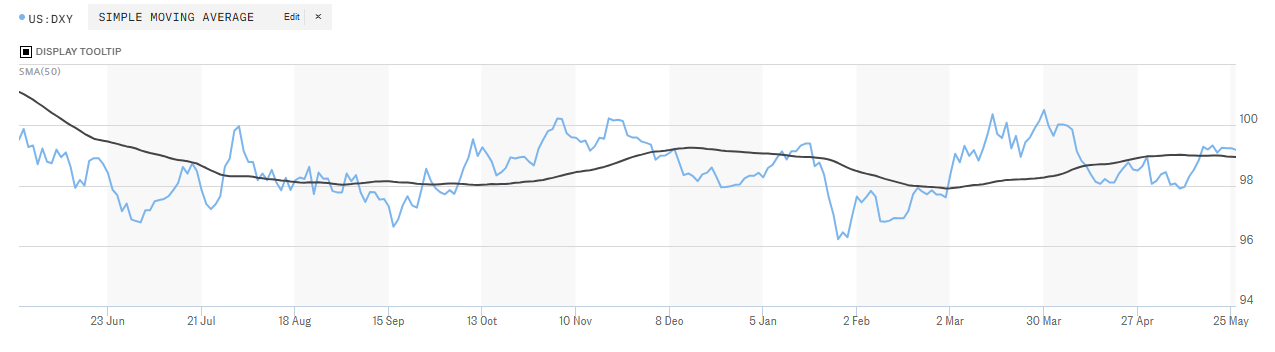
Source: Marketwatch
This effect is interesting because, despite the dollar’s neutrality, the market remains cautious enough not to trigger rapid demand for the yen.
This may be because participants are still waiting before taking clearer positions while the situation in the Middle East becomes more defined. Therefore, as long as there are no relevant updates, the neutrality in the DXY could continue to be reflected in USD/JPY, showing that the yen has still not managed to regain consistent appeal.
Does the long-term outlook remain dominated by interest rates?
The interest rate dynamic between both countries has been one of the main factors influencing the bullish strength in USD/JPY over recent months. In the United States, the benchmark rate remains at 3.75%, while in Japan it stands at 0.75%, reflecting a still-wide differential in favor of the US dollar.
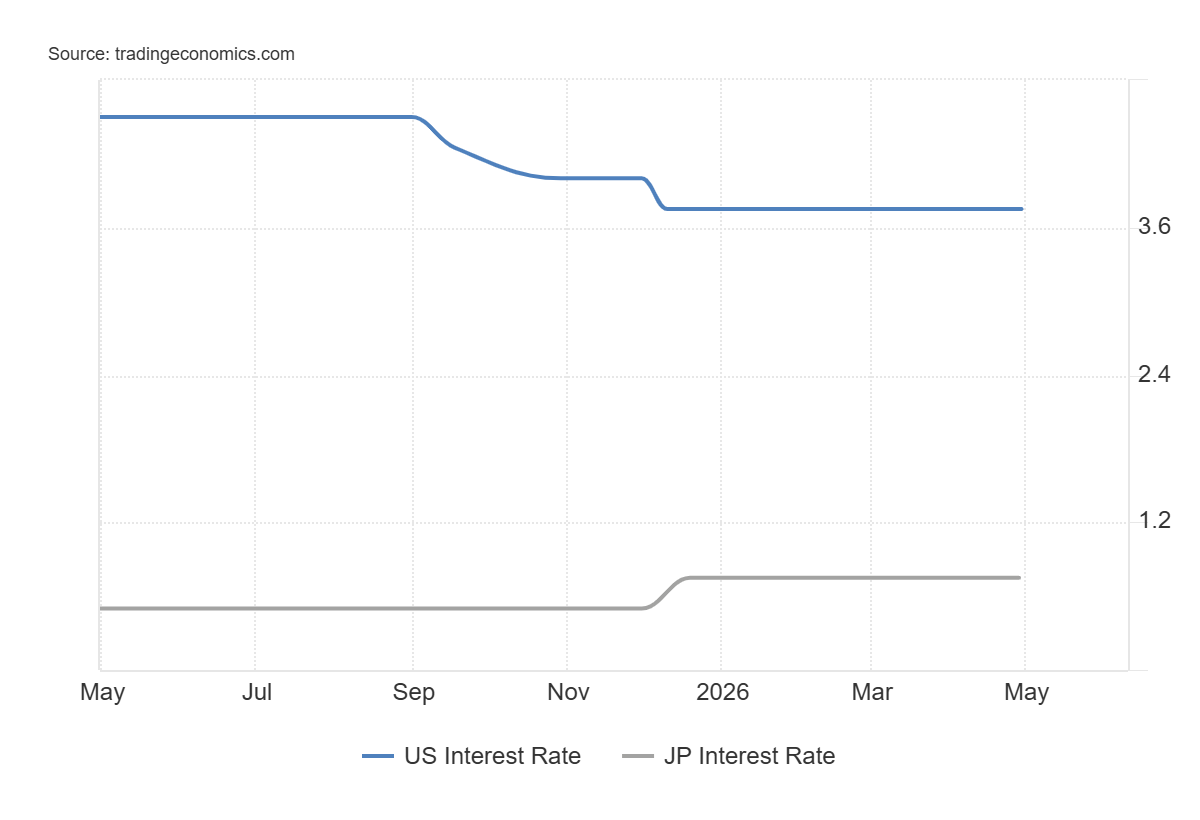
Source: TradingEconomics
In the United States, monetary policy remains in a restrictive pause. The Federal Reserve is facing a scenario of weaker employment momentum, but also potential inflationary pressures linked to the Middle East conflict. For this reason, the institution is expected to maintain a cautious tone in upcoming decisions and keep interest rates unchanged in the short term, reinforcing a controlled neutrality outlook.
In Japan, the outlook appears to follow a similar path in the short term. Although the central bank remains concerned about inflation approaching the 2.00% target and real rates staying very low, the possibility of further rate hikes has not yet materialized clearly. So far, there is still uncertainty over whether the Bank of Japan will keep rates stable or begin applying modest increases in June, which does not provide the market with a clear signal that the differential with the United States will narrow soon. This limits the possibility of consistent demand for the yen.
With all of this in mind, the rate differential remains a key factor. Higher rates in the United States keep the US bond market relatively more attractive than Japan’s, which can attract foreign capital and provide stronger support for dollar demand than yen demand. As long as the Bank of Japan does not decide to raise rates and reduce this differential with the United States, the yen may lack a solid base to recover consistently. This scenario could continue to favor a phase of indecision, and even a potential recovery in USD/JPY, over the medium term.
Technical outlook for USD/JPY
Source: StoneX, Tradingview
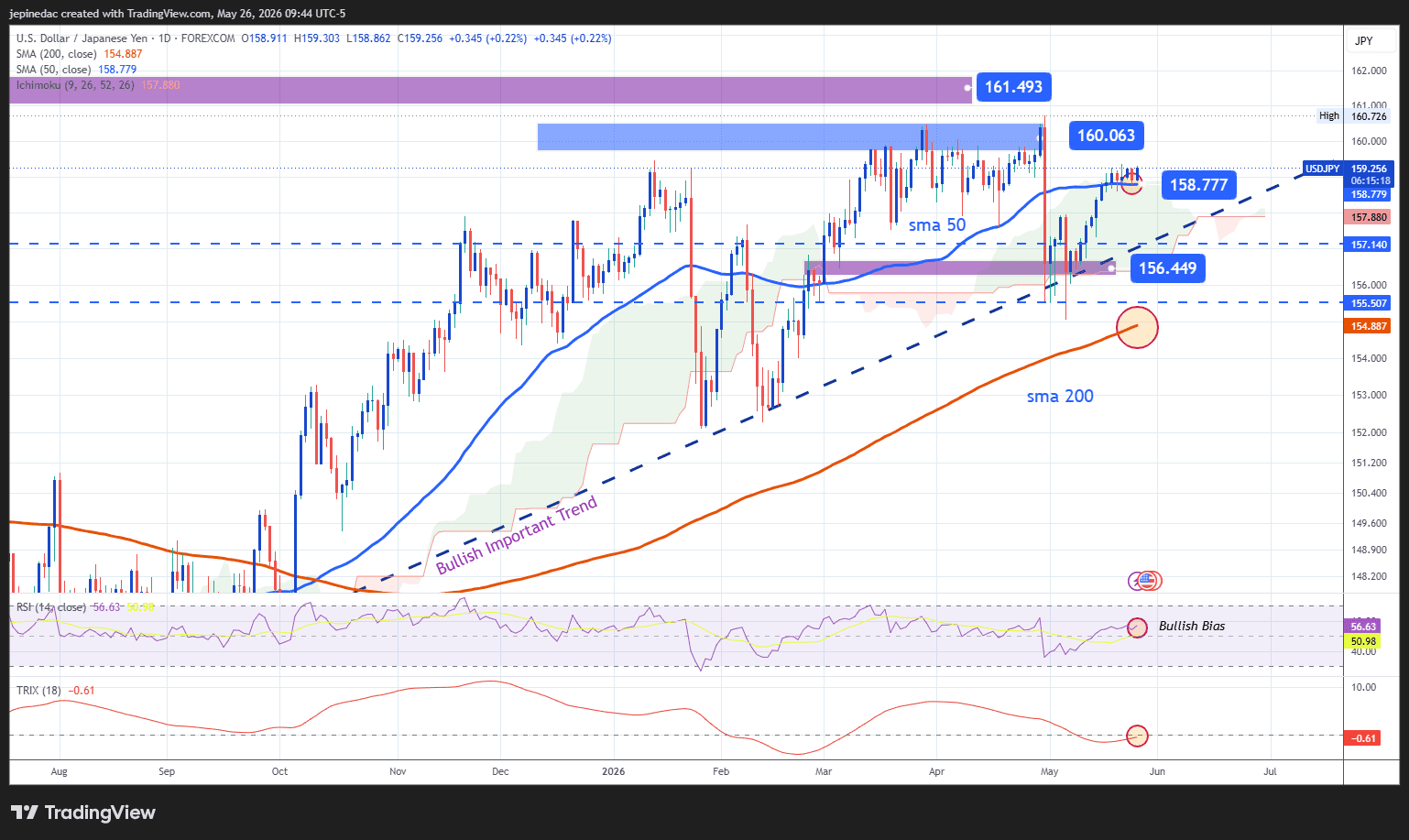
- The bullish trend remains important: Despite the recent neutrality in USD/JPY price action, the daily chart continues to respect a major bullish trendline that has been in place for several months. As long as no relevant selling corrections appear in the short term, this structure could remain the dominant pattern to watch and continue to guide price action over the coming sessions.
- RSI: Now, the RSI continues to show consistent readings above the neutral 50 level, suggesting that average momentum over the last 14 sessions still reflects a relevant buying bias. If this behavior continues, bullish pressure could remain in place over the coming trading sessions.
- TRIX: The TRIX indicator line remains very close to the neutral 0 level, suggesting a balance in the average strength of long-term exponential moving averages. If this behavior continues, it could warn of a possible phase of consistent neutrality over the coming weeks, especially if neither side of the market manages to stabilize.
Key levels:
- 160.000 – Key resistance: A relevant psychological level that coincides with recent highs. Moves toward this area could reinforce the current buying bias and open the door to an extension of the bullish trendline over the coming weeks.
- 158.777 – Near-term barrier: A neutral zone aligned with the 50-period moving average. Price action that remains too close to this level could reinforce a phase of indecision or even lead to the formation of a short-term range.
- 156.449 – Main support: A recent low that coincides with the base of the bullish trendline. This level is critical, as a break below it could fully invalidate the long-term bullish structure and give way to a more dominant selling bias that could extend for several weeks.
Written by Julian Pineda, CFA, CMT – Market Analyst
Follow him on: @julianpineda25




Open an account in minutes
Experience award-winning platforms with fast and secure execution, and enjoy tight spreads from 0.5 pts on FX and 0.3 pts on indices.
Economic calendar
Web Trader platform
Our sophisticated web-based platform is packed with features.
Related articles

EUR/USD Recovers as Markets Fully Price in Fed Hike
EUR/USD outlook turns on Fed pricing, as the euro recovers while strong U.S. data fails to lift a dollar that has already priced in Fed tightening.

How FX Majors Stack Up Against US Dollar Weakness in December
December has historically favoured a weaker US dollar. We compare the seasonal performance and timing of the major currency pairs.


USD/JPY Weekly Outlook: Fed Hikes, AI Volatility and a Sleeping Yen
USD/JPY is tracking the direction of US rates without responding with its usual magnitude. Can Jensen Huang and the payrolls lottery wake the pair from its slumber?

This report is intended for general circulation only. It should not be construed as a recommendation, or an offer (or solicitation of an offer) to buy or sell any financial products. The information provided does not take into account your specific investment objectives, financial situation or particular needs. Before you act on any recommendation that may be contained in this report, independent advice ought to be sought from a financial adviser regarding the suitability of the investment product, taking into account your specific investment objectives, financial situation or particular needs.
StoneX Financial Pte. Ltd., may distribute reports produced by its respective foreign entities or affiliates within the StoneX group of companies or third parties pursuant to an arrangement under Regulation 32C of the Financial Advisers Regulations. Where the report is distributed to a person in Singapore who is not an accredited investor, expert investor or an institutional investor (as defined in the Securities Futures Act), StoneX Financial Pte. Ltd. accepts legal responsibility to such persons for the contents of the report only to the extent required by law. Singapore recipients should contact StoneX Financial Pte. Ltd. at 6826 9988 for matters arising from, or in connection with the report.
In the case of all other recipients of this report, to the extent permitted by applicable laws and regulations neither StoneX Financial Pte. Ltd. nor its associated companies will be responsible or liable for any loss or damage incurred arising out of, or in connection with, any use of the information contained in this report and all such liability is hereby expressly disclaimed. No representation or warranty is made, express or implied, that the content of this report is complete or accurate.
StoneX Financial Pte. Ltd. is not under any obligation to update this report.
Trading CFDs carries a high level of risk that may not be suitable for some investors. Consider your investment objectives, level of experience, financial resources, risk appetite and other relevant circumstances carefully. The possibility exists that you could lose some or all of your investments, including your initial deposits. If in doubt, please seek independent expert advice. Visit www.forex.com/en-sg/terms-and-policies for the complete Risk Disclosure Statement.