



EUR/USD Forecast: Euro Struggles to Find Support Even After U.S. PCE Data
The euro continues to face a challenging environment in the short term. The currency has struggled to regain ground against a U.S. dollar that remains firmly supported, a dynamic reflected in EUR/USD, which has now recorded three consecutive losing sessions and a decline of roughly 0.6%.
Share this:

The euro continues to face a challenging environment in the short term. The currency has struggled to regain ground against a U.S. dollar that remains firmly supported, a dynamic reflected in EUR/USD, which has now recorded three consecutive losing sessions and a decline of roughly 0.6%. More importantly, selling pressure has persisted even after the latest U.S. inflation data was released, suggesting that the market continues to favor the dollar over the euro. As long as this backdrop remains in place, bearish pressure could continue to play an important role in EUR/USD price action over the coming sessions.

PCE Takes Center Stage
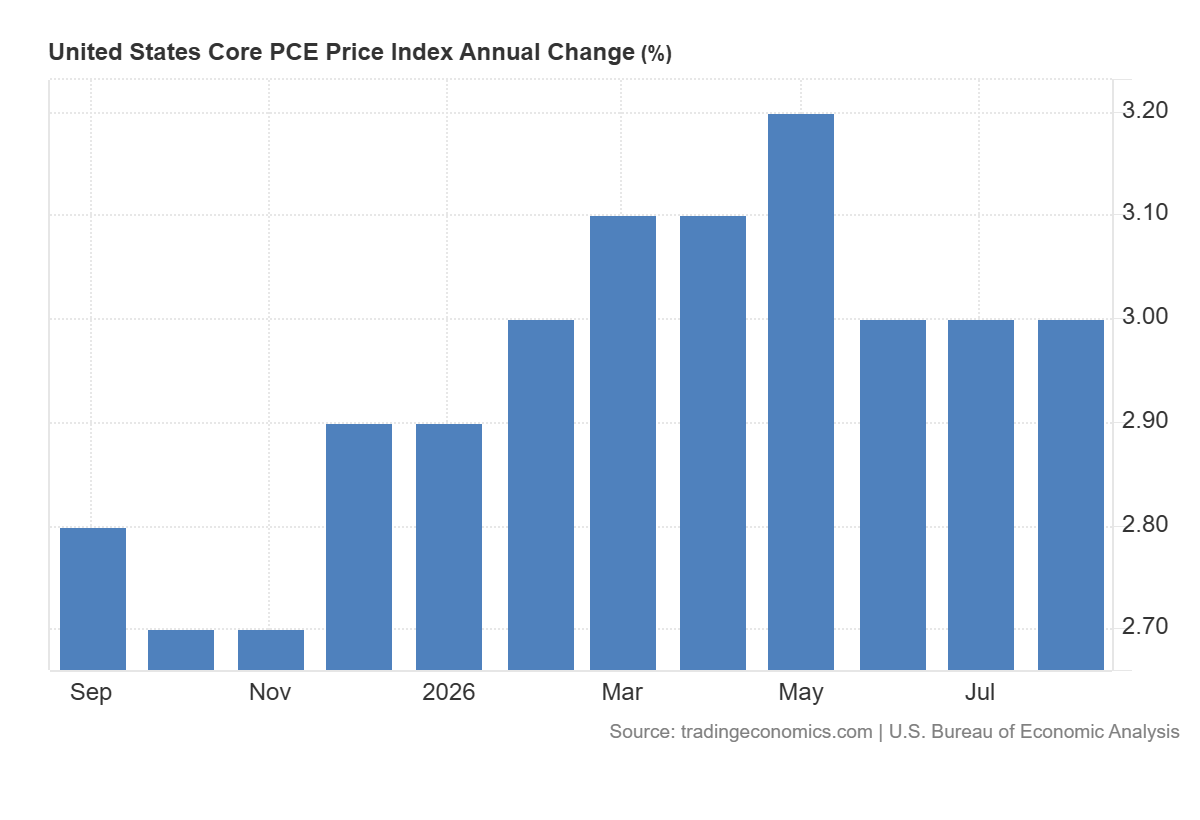
One of the most important events of the trading session was the release of the U.S. Core Personal Consumption Expenditures (Core PCE) report, one of the Federal Reserve's preferred inflation gauges and a key indicator of consumer price trends.
The monthly reading came in at 0.2%, below market expectations of 0.3%. At first glance, this provided some relief by suggesting a modest easing in short-term inflation pressures. However, the annual measure remains close to 3.0%, a level that has shown little change since June. While inflation is no longer accelerating significantly, it also remains well above the Federal Reserve's long-term target.
As a result, markets have slightly reduced expectations of a more aggressive Fed. According to CME Group probabilities, there is now roughly a 60% chance that interest rates will remain unchanged at 4.00% during the October 28 meeting.
Source: TradingEconomics
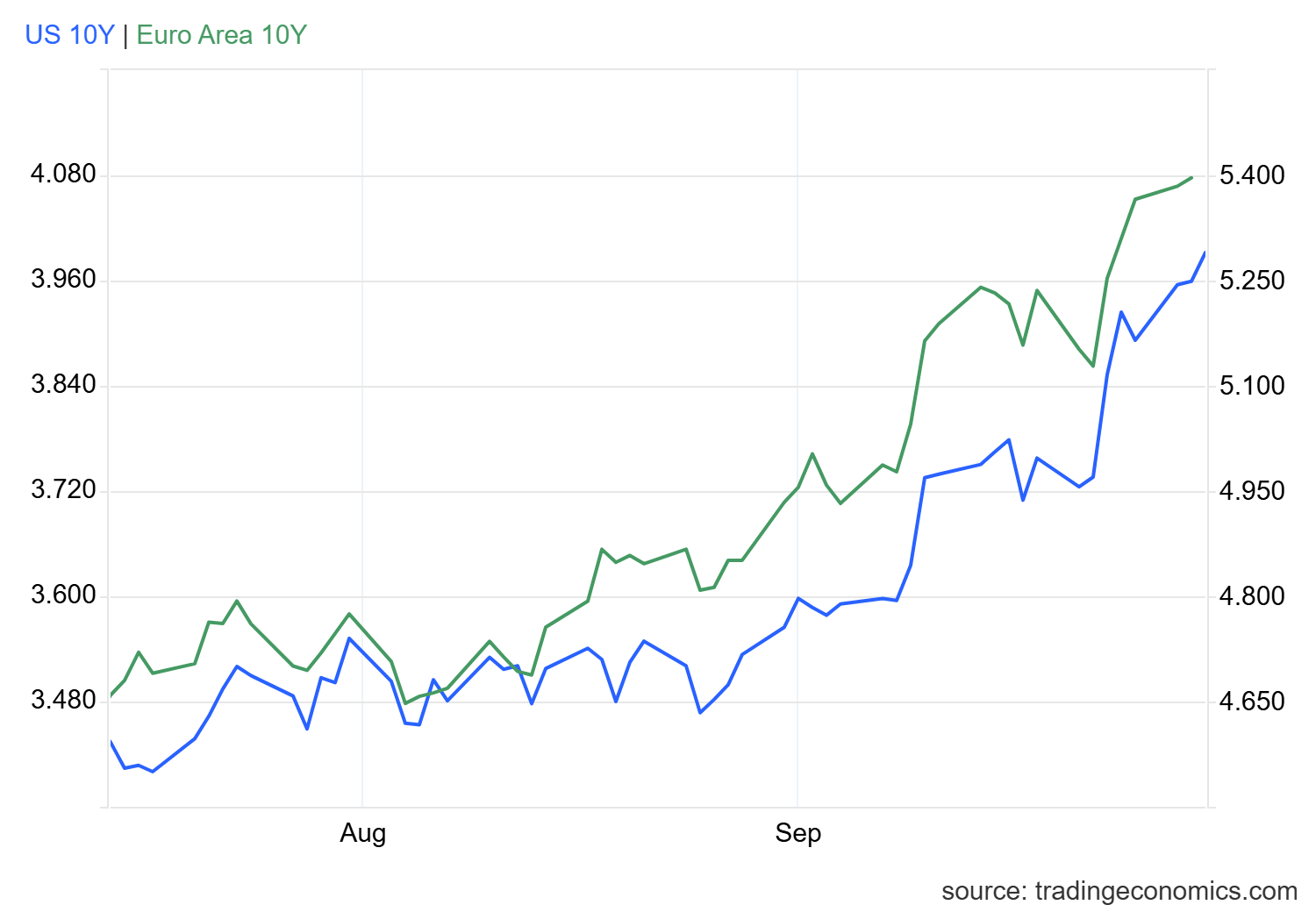
Even so, the positive impact on the euro has been limited because the U.S. bond market continues to show remarkable strength. Despite the moderation in rate expectations, 10-year Treasury yields continue to move higher and are now approaching the 5.3% area, levels not seen in decades. Meanwhile, European bond yields have also recovered recently, but they remain significantly lower, trading closer to 4.0%.
This yield differential continues to support the relative attractiveness of U.S. assets and helps explain why demand for the dollar remains strong despite the softer inflation release.
Source: TradingEconomics
Against this backdrop, the euro continues to face a difficult environment. Although the inflation data partially reduced expectations of a more aggressive Federal Reserve, the bond yield differential continues to favor the United States. As long as this situation remains unchanged, the euro may continue to struggle to attract consistent demand, leaving the current selling pressure around EUR/USD in place over the coming sessions.
Is the ECB Still Relevant?
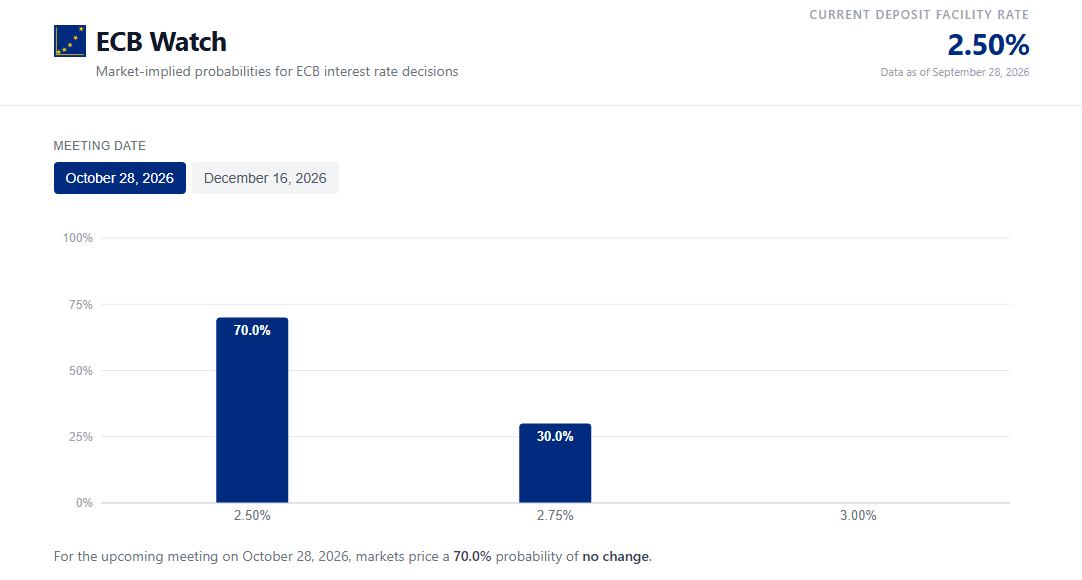
It is also important to monitor developments surrounding the European Central Bank (ECB). Current market probabilities continue to reflect a relatively neutral stance from policymakers. Expectations for the October 28 meeting indicate roughly a 70% probability that the ECB's deposit rate will remain unchanged at 2.5%.
These expectations are largely driven by the fact that inflation pressures across Europe have not been strong enough to justify another aggressive tightening cycle. In addition, ECB officials have maintained a relatively cautious tone in recent weeks, reinforcing expectations of policy stability.
Source: ECBWATCH
This remains important because part of the dollar's recent strength continues to be supported by the interest-rate differential between the United States and Europe. Unless markets begin to see signs of a more hawkish ECB willing to narrow that gap, dollar-denominated assets may continue to retain a meaningful relative advantage. Under this scenario, the euro could remain under pressure, leaving EUR/USD vulnerable to further downside in the near term.
EUR/USD Technical Forecast
Source: StoneX, Tradingview
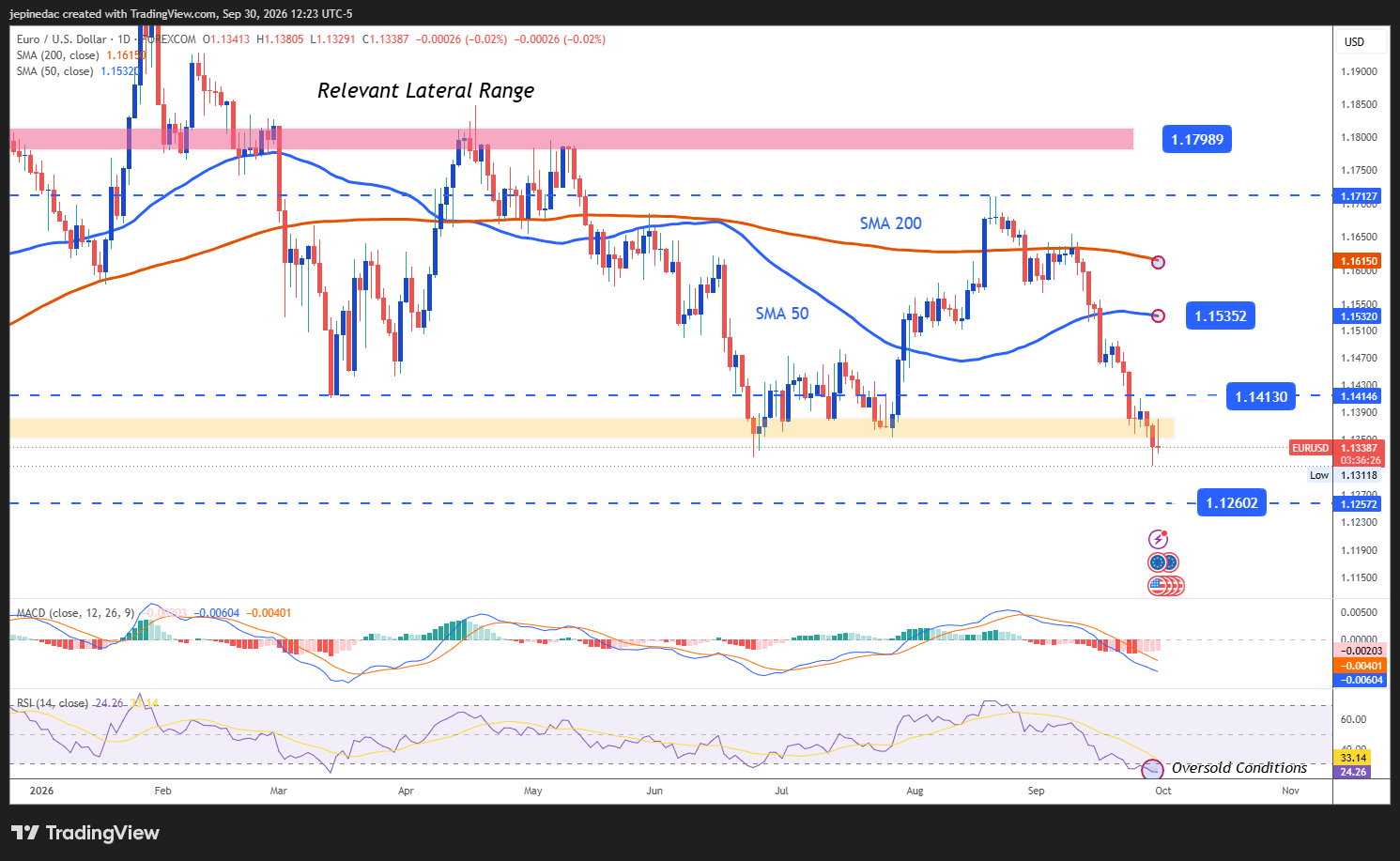
- The broad trading range is entering a risk zone: For much of 2026, EUR/USD has traded within a wide consolidation range that has dominated price action and prevented the development of a sustained directional trend. However, recent weakness has placed the lower boundary of that structure under increasing pressure. If selling pressure continues to build, a bearish breakout could emerge and open the door to a more established downward trend.
- MACD: The MACD histogram continues to trade below the 0 neutral line, indicating that short-term moving-average strength remains biased to the downside. As long as this behavior persists, selling pressure may continue to dominate.
- RSI: A similar picture can be observed in the RSI, which remains below the 50 neutral level. This reading reinforces the relevance of bearish momentum within the market. However, the indicator is now also trading below the 30 oversold threshold, suggesting that recent selling pressure may have become excessive and could create room for short-term bullish corrections.
Key Levels:
- 1.15352 – Key Resistance: This level coincides with the 50-period simple moving average and represents the most important barrier for recovery attempts. Price action returning toward this area could reinforce the importance of the broad trading range that has dominated much of the year and restore a more neutral tone to the chart.
- 1.14130 – Near-Term Barrier: A key retracement area observed over recent weeks that could become the primary reference to monitor in the event of short-term bullish corrections.
- 1.12602 – Critical Support: A level not seen since May 2025 that represents the most important downside barrier below the current trading range. Sustained moves toward this area could confirm the end of the broader consolidation structure and open the door to a more established bearish trend.
Written by Julian Pineda, CFA, CMT – Market Analyst
Follow him on: @julianpineda25


Open an account in minutes
Experience award-winning platforms with fast and secure execution.
Economic calendar
Web Trader platform
Our sophisticated web-based platform is packed with features.
Related articles

Gold Outlook: Can XAU/USD Sustain Its Recent Rebound?
The trading week is coming to an end, and gold continues to exhibit a lack of clear direction in the short term. Although the precious metal spent most of the week under pressure, it managed to recover more than 2.3% heading into the close, reclaiming part of its recent losses. Even so, the rebound remains insufficient to sustain consistent moves above the $3,700 per ounce level.

US dollar outlook: Fed hike priced | FOREX Friday
A December Fed rate hike looks fully priced in, as the dollar stays below this week's highs despite strong US data, while gold, silver and the EUR/USD rebound. Fawad Razaqzada explains why next week's jobs report is the main event, and the Dollar Index levels to watch.

EUR/USD Recovers as Markets Fully Price in Fed Hike
EUR/USD outlook turns on Fed pricing, as the euro recovers while strong U.S. data fails to lift a dollar that has already priced in Fed tightening.
StoneX Financial Ltd (trading as "FOREX.com") is an execution-only service provider. This material, whether or not it states any opinions, is for general information purposes only and it does not take into account your personal circumstances or objectives. This material has been prepared using the thoughts and opinions of the author and these may change. However, FOREX.com does not plan to provide further updates to any material once published and it is not under any obligation to keep this material up to date.
This material is short term in nature and may only relate to facts and circumstances existing at a specific time or day. Nothing in this material is (or should be considered to be) financial, investment, legal, tax or other advice and no reliance should be placed on it. No opinion given in this material constitutes a recommendation by FOREX.com or the author that any particular investment, security, transaction or investment strategy is suitable for any specific person.
The material has not been prepared in accordance with legal requirements designed to promote the independence of investment research. Although FOREX.com is not specifically prevented from dealing before providing this material, FOREX.com does not seek to take advantage of the material prior to its dissemination. This material is not intended for distribution to, or use by, any person in any country or jurisdiction where such distribution or use would be contrary to local law or regulation. For further details see our full non-independent research disclaimer and quarterly summary.