
FAQs
Get help with your trading account or browse answers on specific markets and products.
Popular FAQs
About FOREX.com
VIP
CFDs
Charting tools
Commodities
Cryptocurrency
Cryptocurrencies weekend trading
Demo accounts
Education
Extended hours
Forex trading
FOREX.com desktop platform
FOREX.com mobile trading apps
FOREX.com Web Trader platform
Funding
Indices
Limit up/limit down
Liquidation
Margin and leverage
Market analysis
Metals
MetaTrader
Opening an account
Orders and execution
Passwords and account settings
Performance Analytics
Pricing and fees
RAW spread account
Rollover
Shares
Trading halts
TradingView
Withdrawals
Commodities trading FAQs
Browse this FAQ section for more information about commodities trading.
With FOREX.com, you can trade crude oil, natural gas, corn and more as CFDs. Click here to view our range of markets.
A CFD, or contract for difference, is an agreement to exchange the difference between the opening and closing price of the position under contract, rather than buying and selling the underlying security outright.
FOREX.com is compensated by the spread, which is the difference between the bid and ask prices. View our live spreads.
In addition, you may be charged a nightly finance charge if you hold a position overnight, after 5pm ET.
With most CFDs, financing is debited for long positions or credited for short positions daily if you are in a position at 5pm ET.
These charges are typically calculated as follows:
F=(S x P x R)/D
F - Daily Financing Charge
S - Number of CFDs (2500)
P - Closing Price
R - Relevant interest rate benchmark, +250 basis points for long positions or -250 basis points for short positions, e.g. (4.50% + 3.00%) = 7.50%
D - Number of days, i.e. 365 for UK stocks and 360 for all others
FOREX.com offers two types of CFDs: Futures CFDs, which are dated for a specific contract month and expire automatically at the end of their contract period, and Cash CFDs, which do not expire. Visit How are Non-Expiring Commodities (NEC) priced? for more information on Cash Commodity CFDs. Note that only Futures CFDs are available on the MetaTrader 4 platform. Standard expiry definitions are available in the table below. To see the exact Last Dealing Time for each market, check the Market 360 tab on the for each market on the FOREX.com Web Trading platform, or the under the Company tab in the Terminal window of MetaTrader 4.
If you don't close a Futures CFD position before the Last Dealing Time, it will be closed automatically once the applicable closing price has been determined, and any open orders will be cancelled. The closing price will be determined by reference to the underlying futures market and may be the official settlement price, the last traded price, or another value reported by the relevant exchange on the day of expiry, as applicable. Alternatively, you can tick Autoroll, which will roll your Futures position to the next contract month prior to expiry. Please note that Autoroll closes the expiring contract and realizes any profit or loss before opening a new position in the next contract month. For MetaTrader 4 accounts, to keep your exposure, you must manually open a new position in the next contract month after expiry, as MetaTrader does not support the Autoroll function.
To price these non-expiring markets, we use two sufficiently liquid futures contracts on the underlying commodity. This is usually the two with the nearest expiry date.
The contract with the closest expiry date is called the Front month contract and the second-nearest expiry date is called the Far month contract.
Throughout the duration of the Front month contract, the price of the NEC will gradually move from the price of the front month to the price of the far month.
As there will be an adjustment to the NEC Market price every day, your account will be subject to an adjustment in the form of a Credit/Debit to offset this price adjustment. For example, if the NEC contract is adjusted by +2 points, clients with long positions will be debited 2 x stake and clients with short positions will be credited 2 x stake. See further explanation and video below.
In our video, the front month is labelled ‘A’ and the far month ‘B’.
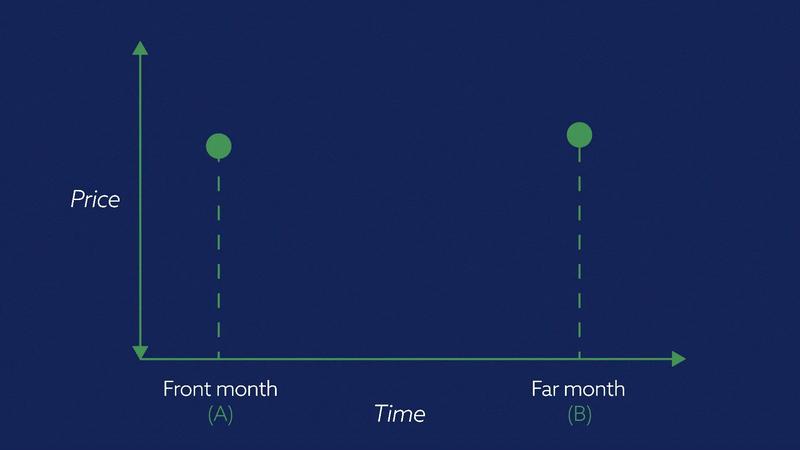
NEC contract market prices move from the price of market ‘A’ towards the price of market ‘B’ as the expiry date of ‘A’ becomes closer. The price of market ‘B’ may be higher or lower, depending on the commodity, than that of market ‘A’.
Daily adjustments for NEC contract markets reflect a day’s movement from ‘A’ towards ‘B’.
In addition, a cost of carry will be applied to represent the NEC as a cash asset.
This will be observed as a movement up daily (inc. weekends) during the close period of Underlying Ccy Overnight Rate Last Price / 365*. This reflects the cost of carry being paid by longs and received by shorts. This is, in essence, the cost of rolling to a new value date and explained in more detail below.
E.g. In US Crude with the price at $7800 and an USD overnight rate of 5.3%, this adjustment is 1.1 pips daily.
Cost of Carry Logic
A client can either buy an asset now and pay to borrow the cash for a day, or they can buy it tomorrow and pay one day’s less interest. Put another way, someone with $1000 can either buy $1000 of an asset today or receive one day's interest XX on that $1000 and buy $1000.XX of that asset tomorrow.
Both outcomes must be equal; this is the cash-futures parity. Otherwise, there is an arb, and everyone buys today and not tomorrow, or vice versa.
This is observed in Indices, where (ignoring dividends) the cash price moves up towards the future daily as the cost of carry to expiry reduces. We are applying this same logic to Cash Commodities.
Margins for commodities vary according to the market and type of account.
For more information on a specific market, please check the Key Market Information or Market 360 within the trading platform, or explore our margin requirements page.
The formula to calculate how much margin is required is quantity x price x margin.
Changes Affecting Oil Trades:
Scenario | Change |
|---|---|
Oil price drops below $5.00 | In the event the price of any of our oil contracts drops below $5.00/barrel, trading restrictions may then apply as follows: - Not allowing any new opening orders or trades, which includes resting orders to open. Pending orders would remain on the clients account and become executable when the price is back above $5.00 and stabilizes. - Existing open (long and short) positions switching to close-only, with no ability to add to the position until the price is back above $5.00 and stabilizes. Note: FOREX.com will determine at its sole discretion when it believes the market has stabilized and when to re-open the market, allowing the ability for clients to initiate new position(s) and/or add to existing position(s). |
Oil price reaches zero | In the event the price of any our oil contracts reaches or falls below zero, we will close any long or short positions on that market at the current available market price. Please note that the underlying price could be negative at the time of closing, and if such, we reserve the right to adjust the trading account accordingly. |
Markets affected:
Platform | Market(s) |
|---|---|
Web Trader | US Crude Oil (all contracts) UK Crude Oil (all contracts) |
MT5 | US Crude Oil (all contracts) UK Crude Oil (all contracts) |
US Crude Oil 7-Day is a standalone WTI Crude Oil Cash CFD product that is available during standard weekday trading hours and remains open most of Saturday and Sunday, allowing you to react to geopolitical, economic, and market-moving events outside traditional oil market hours. Trading pauses for a short period on Sunday before weekday market pricing resumes.
When can I trade US Crude Oil 7-Day?
US Crude Oil 7-Day is tradeable 7 days and week with the following trading breaks:
- Sunday to Thursday: from 5 PM ET to 6 PM ET
- Friday: from 5 PM ET, reopening on Saturday at 4 AM ET
Please review the Market Information Sheet on the platform for exact trading hours.
How does pricing work?
During standard market hours, pricing follows our standard US Crude Oil pricing methodology, which references the underlying WTI market. When the traditional WTI futures market is closed during the weekend, pricing is derived from alternative crude oil reference markets and other relevant market information available to FOREX.com. Pricing adjustments may be applied to reflect differences between weekend reference markets and the traditional WTI market. When the traditional WTI futures market reopens, pricing returns to the standard US Crude Oil pricing methodology.
Weekend spreads may be wider than during standard market hours. In exceptional circumstances, trading may be restricted, paused, or made close-only.
How do positions work for US Crude Oil 7-Day?
US Crude Oil 7-Day is a separate market from the standard US Crude Oil CFD. Positions, margin requirements, and profit and loss are managed independently, and positions in one market will not offset, transfer to, or roll into the other.