



Crude oil forecast: How much further can WTI fall?
Oil prices initially opened higher following weekend reports that Iran had once again moved to restrict activity through the Strait of Hormuz. However, that early strength quickly faded, with crude retreating towards levels seen at the end of last week. At the time of writing, WTI crude was down around 2.5%, hovering near intraday lows. Part of the weakness reflects the fact that the strait was not completely shut, despite shipping data showing a notable decline in vessel traffic. More importantly, investors have responded positively to diplomatic developments in the region.
Share this:

Oil prices initially opened higher following weekend reports that Iran had once again moved to restrict activity through the Strait of Hormuz. However, that early strength quickly faded, with crude retreating towards levels seen at the end of last week. At the time of writing, WTI crude was down around 2.5%, hovering near intraday lows. Part of the weakness reflects the fact that the strait was not completely shut, despite shipping data showing a notable decline in vessel traffic. More importantly, investors have responded positively to diplomatic developments in the region. The first round of talks between Washington and Tehran concluded with what Iranian Foreign Minister Abbas Araghchi described as “major progress” while securing a ceasefire in Lebanon also appeared to advance. With efforts towards a lasting peace ongoing, this could put further pressure on crude oil forecast in the near-term. That said, the scope for a deeper sell-off may be limited given that much of the geopolitical premium has already been removed from prices and underlying demand remains resilient.
Inventory rebuilding could help stabilise the market
For now, the market’s immediate direction still appears tilted to the downside as tensions in the Middle East ease. Crude has already surrendered most of the gains accumulated during the conflict period. Oil prices are now approaching the range that prevailed before disruptions intensified, suggesting that most of the war-related premium has been priced out. Prior to the war, WTI was trading in the $65-$66 per barrel region, an area that could provide meaningful support if prices continue to retreat.
However, the disruptions affecting the Strait of Hormuz over recent months has created a significant imbalance between supply and demand, tightening global markets and reducing available inventories. So, even if WTI were to return to pre-war levels, don’t expect it to continue heading south.
For one thing, releases from strategic reserves, which helped offset some of the supply shortfall experienced during the disruption, will need to be replenished. As prices retreat, many countries will likely look to rebuild inventories that were drawn down during the period of heightened uncertainty. Major consumers including China, Japan and the United States may take advantage of lower prices to replenish reserves. Such buying activity could provide an important source of support for the crude oil forecast over the coming weeks.
That said, stronger demand may be partly offset by rising output from producers including Iran and Venezuela. Unless geopolitical tensions flare up again, additional supply could cap any meaningful upside in prices.
Another factor worth watching is the US dollar. A stronger greenback typically weighs on dollar-denominated commodities, creating an additional headwind for both oil and precious metals.
Why a sharp collapse still looks unlikely
While further near-term downside cannot be ruled out, the conditions for a dramatic collapse in oil prices do not appear to be in place.
The direction of the crude oil forecast from here will largely depend on how supply growth balances against demand trends. On the consumption side, several supportive factors remain intact.
Strategic reserve replenishment programmes are likely to generate fresh demand, while the US summer driving season should continue to underpin fuel consumption. Seasonal strength in gasoline demand could help keep inventories relatively tight, even as OPEC members and Iran gradually increase production.
As a result, any additional weakness in crude may prove more measured than aggressive, particularly if demand remains robust through the third quarter, or if the return to pre-war production levels prove to be more difficult than expected.
WTI technical outlook
From a technical perspective, WTI has been trending lower for several weeks, leaving momentum indicators increasingly stretched to the downside.
That raises the possibility of a corrective rebound on oil prices, particularly if geopolitical tensions re-emerge and threaten supply routes through the Strait of Hormuz or other strategically important areas.
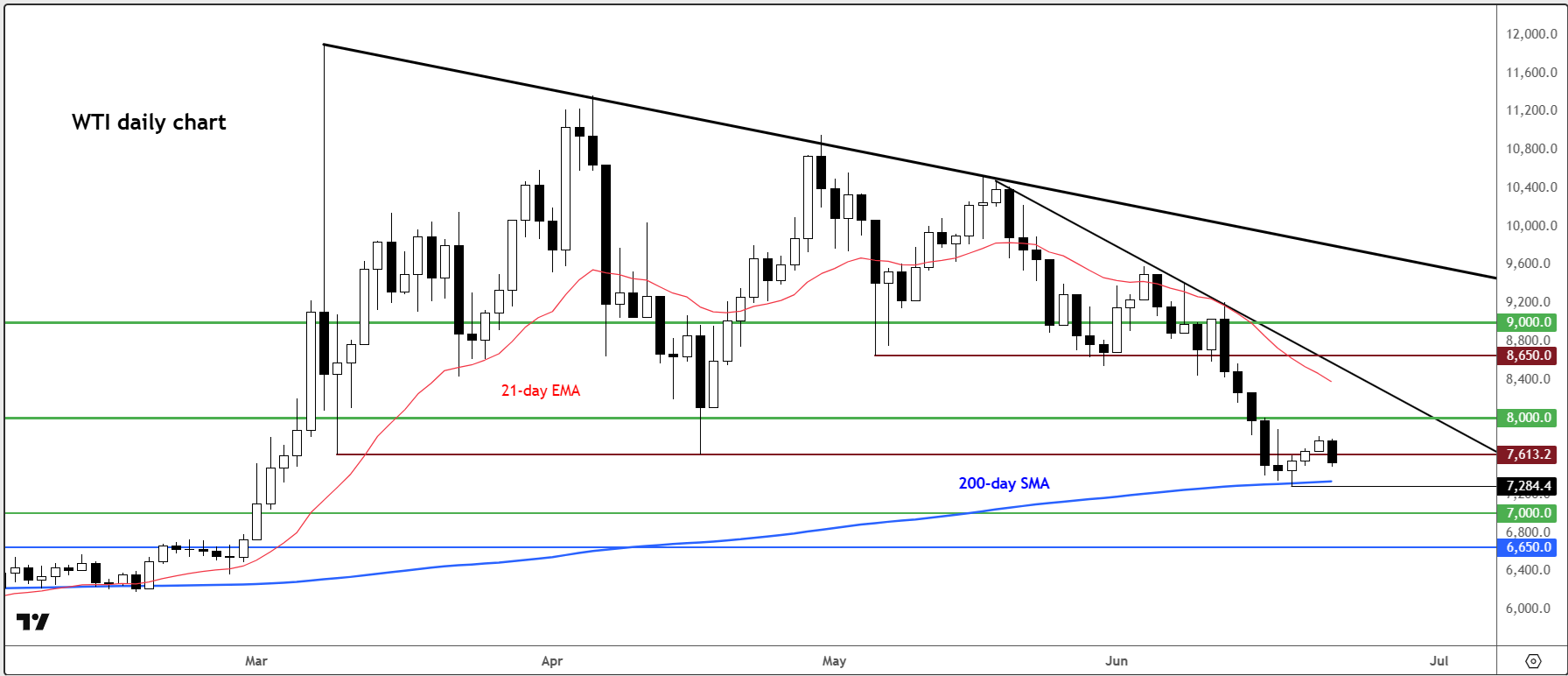
WTI was testing the $73-$74 per barrel region at the time of writing. This area represents a support zone as prices managed to hold above here during the final sessions of last week, while the 200-day moving average is also located nearby, reinforcing its significance.
Should that support fail, attention would likely shift towards the psychologically important $70 level. Below that, traders may focus on the pre-conflict trading range near $66-67 per barrel.
On the upside, the first key resistance level comes in around $76.10. This area acted as support earlier in the year before eventually giving way, and recent price action suggests it is now functioning as resistance.
A move above $76.10 would improve the short-term technical outlook and could open the door to a recovery towards $80 per barrel. In the event of a significant resurgence in Middle East tensions, a move into the $85-$86 region cannot be ruled out.

-- Written by Fawad Razaqzada, Market Analyst
Follow Fawad on Twitter @Trader_F_R
Related tags:

Open an account in minutes
Experience award-winning platforms with fast and secure execution.
Economic calendar
Live trading webinars
Our interactive webinars, led by our industry experts, come highly recommended and can help provide your trading with the edge it needs.
Related articles

Nasdaq 100 forecast: Stocks rebound, but have markets found a floor?
US equities have recovered sharply after last week’s bruising sell-off, as confidence in Nvidia draws investors back into technology stocks. But a busy economic calendar, led by the November jobs report, will test whether the rebound has legs.

US dollar outlook: Fed hike priced | FOREX Friday
A December Fed rate hike looks fully priced in, as the dollar stays below this week's highs despite strong US data, while gold, silver and the EUR/USD rebound. Fawad Razaqzada explains why next week's jobs report is the main event, and the Dollar Index levels to watch.

EUR/USD Recovers as Markets Fully Price in Fed Hike
EUR/USD outlook turns on Fed pricing, as the euro recovers while strong U.S. data fails to lift a dollar that has already priced in Fed tightening.
The information on this web site is not targeted at the general public of any particular country. It is not intended for distribution to residents in any country where such distribution or use would contravene any local law or regulatory requirement. The information and opinions in this report are for general information use only and are not intended as an offer or solicitation with respect to the purchase or sale of any currency or CFD contract. All opinions and information contained in this report are subject to change without notice. This report has been prepared without regard to the specific investment objectives, financial situation and needs of any particular recipient. Any references to historical price movements or levels is informational based on our analysis and we do not represent or warranty that any such movements or levels are likely to reoccur in the future. While the information contained herein was obtained from sources believed to be reliable, author does not guarantee its accuracy or completeness, nor does author assume any liability for any direct, indirect or consequential loss that may result from the reliance by any person upon any such information or opinions.
Futures, Options on Futures, Foreign Exchange and other leveraged products involves significant risk of loss and is not suitable for all investors. Losses can exceed your deposits. Increasing leverage increases risk. Spot Gold and Silver contracts are not subject to regulation under the U.S. Commodity Exchange Act. Contracts for Difference (CFDs) are not available for US residents. Products and services available depend on your location and the entity holding your account. Before deciding to trade forex, commodity futures, or digital assets, you should carefully consider your financial objectives, level of experience and risk appetite. Any opinions, news, research, analyses, prices or other information contained herein is intended as general information about the subject matter covered and is provided with the understanding that we do not provide any investment, legal, or tax advice. You should consult with appropriate counsel or other advisors on all investment, legal, or tax matters. References to FOREX.com or GAIN Capital refer to StoneX Group Inc. and its subsidiaries. Please read Characteristics and Risks of Standardized Options.