


Crude Oil Analysis: Geopolitical Risk Continues to Drive the WTI Barrel Higher
During recent trading sessions, a new wave of buying momentum has continued to gain relevance around WTI crude oil price action. Over the last three trading sessions, the market has maintained a bullish streak and is now up more than 5.5%, highlighting significant buying pressure in the short term.
Share this:

During recent trading sessions, a new wave of buying momentum has continued to gain relevance around WTI crude oil price action. Over the last three trading sessions, the market has maintained a bullish streak and is now up more than 5.5%, highlighting significant buying pressure in the short term.
For now, this dynamic has remained in place as tensions continue to escalate around the conflict in the Middle East, a situation that keeps increasing the geopolitical risk premium across the region. As long as new developments continue pointing toward a prolonged escalation, the current buying pressure around the WTI barrel could remain relevant over the coming sessions.

How Is the Situation in the Middle East Evolving?
Over recent trading sessions, concerns about a further escalation in the Middle East have once again gained relevance after reports emerged of new attacks by the United States against Iranian tankers. This situation has renewed concerns about prolonged disruptions to oil flows in the short term.
In addition, Iran announced the establishment of an exclusion zone near the Strait of Hormuz, increasing risks for vessels attempting to navigate the area in the coming weeks. At the same time, there are still no meaningful diplomatic developments that would suggest a clear path toward a peaceful resolution of the conflict in the short term.
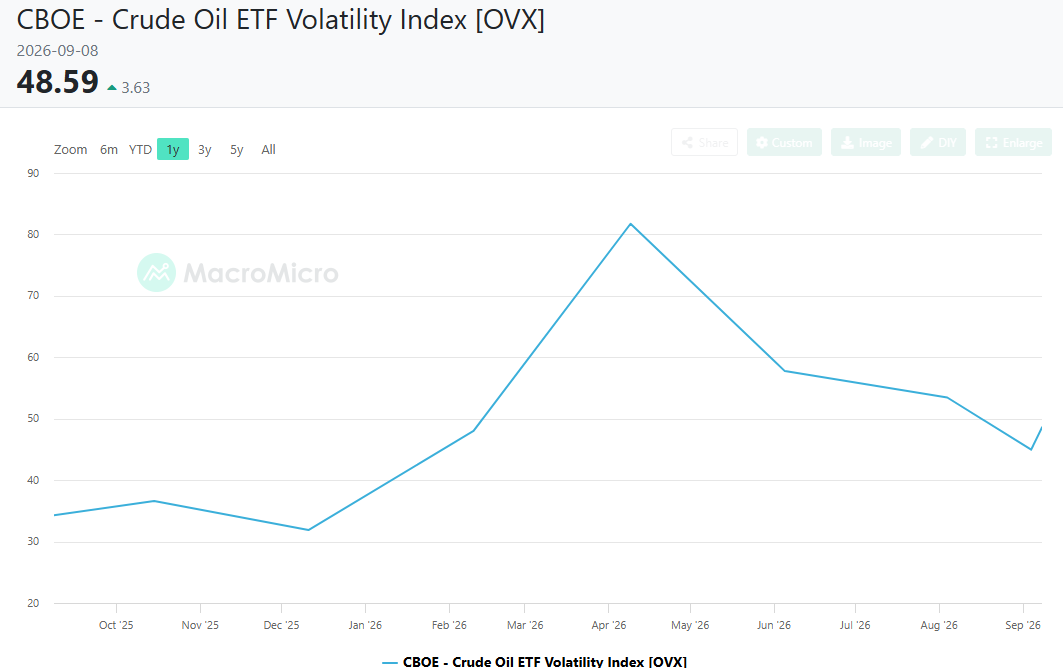
This series of developments has once again increased uncertainty around oil price movements, mainly because concerns over potential supply disruptions continue to remain present and could become more significant in the months ahead. As a result, this situation is also beginning to be reflected in the behavior of the OVX Index, which has advanced toward the 50-point area during the latest session. Since the indicator measures expected volatility over the next 30 days, its recent behavior suggests that uncertainty surrounding potentially aggressive market moves is increasing once again following the renewed tensions between Iran and the United States.
Source: MacroMicro – Data: CBOE
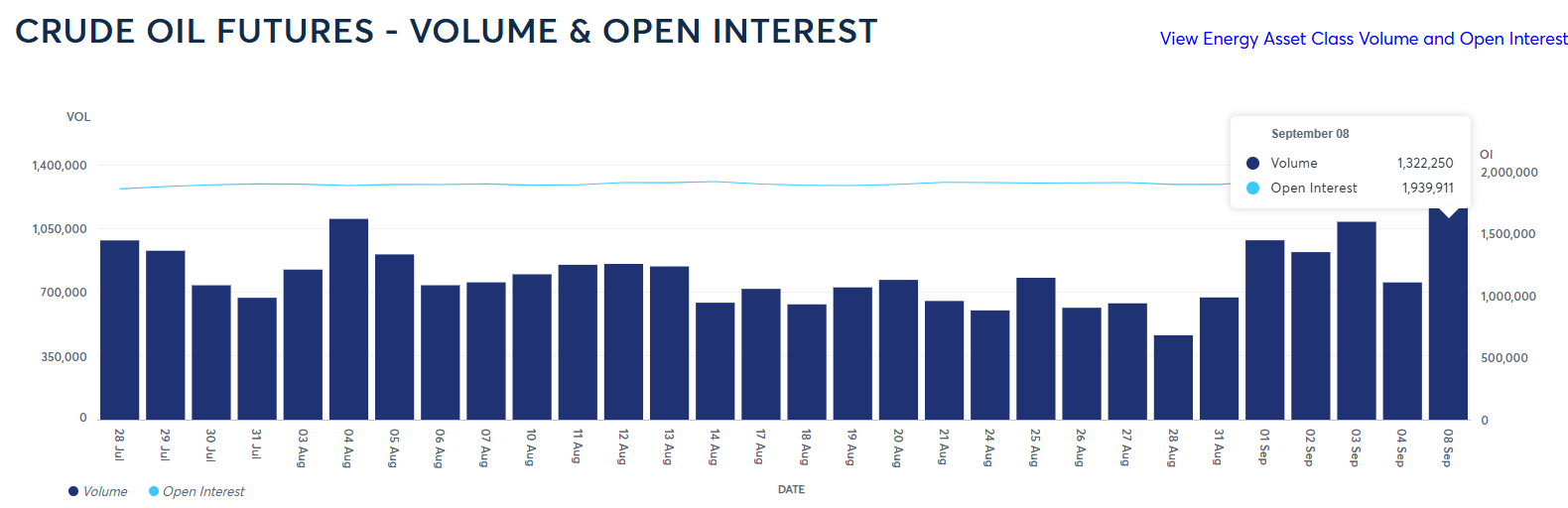
In addition, it is important to highlight that the resurgence of tensions has not only increased expectations of volatility around crude oil but has also boosted activity within the futures market. Current data shows a new high in trading volume not seen in several months. Data for September 8 registered more than 1.3 million contracts traded in a single session.
This development not only reflects increasing activity within the futures market, but also suggests that demand for crude oil is becoming more active as prices continue to advance. Part of this behavior may be linked to hedging strategies aimed at securing barrels in the present amid concerns that supply conditions could become more challenging in the future. Overall, market activity appears to be increasing as uncertainty surrounding the evolution of the conflict remains elevated.
Source: CMEGROUP
Taking all of this into account, potential supply disruptions remain the most important fundamental catalyst for the oil market in the short term. If upcoming developments continue to point toward difficulties in reaching reliable negotiations in the Middle East and uncertainty surrounding a stable supply environment remains present, expectations for more aggressive moves in crude oil prices could continue to build. Under this scenario, buying pressure around WTI may remain relevant over the coming weeks.
WTI Technical Outlook
Source: StoneX, Tradingview
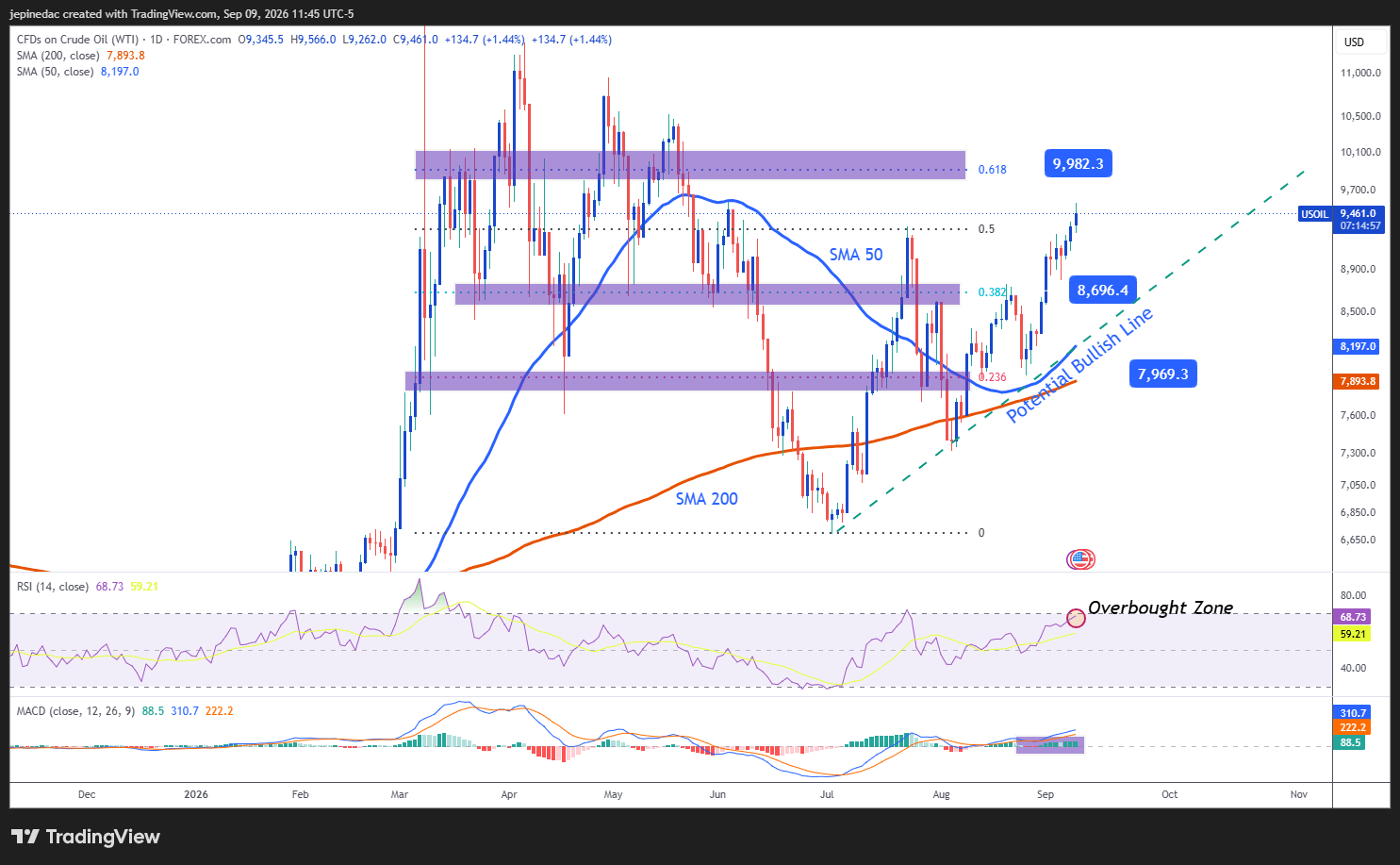
- A Potential Trendline Continues to Gain Relevance: Price action over recent weeks has gradually begun to shape a potential bullish trendline that is becoming increasingly important on the daily chart. The sequence of higher highs continues to highlight that the dominant market bias remains bullish. As long as buying pressure remains stable, this structure could continue strengthening and eventually become the most important technical pattern to monitor over the coming weeks.
- RSI: The RSI continues to develop above the neutral 50 level, a reading that reflects that buying momentum remains relevant in the short term. However, it is also important to note that the indicator is gradually approaching the overbought zone marked by the 70 level. This situation may be signaling a potential excess of recent buying pressure and could begin opening the door for corrective pullbacks during upcoming sessions.
- MACD: The MACD histogram continues to hold above the neutral 0 line, suggesting that the average strength of short-term moving averages remains supportive of a bullish bias. As long as this behavior persists, upside pressure could continue to play an important role in WTI price action.
Key Levels to Watch:
- $99 – Key Resistance: An important resistance area that coincides with previous highs and the 61.8% Fibonacci retracement of the most relevant move on the chart. Price action that manages to establish itself above this level could reinforce the emergence of a more dominant bullish bias and even create room for a more aggressive bullish trendline within the daily chart.
- $86 – Critical Barrier: This area corresponds to the 38.2% Fibonacci retracement level and stands as the nearest reference to monitor should corrective downside moves begin to develop in the short term.
- $80 – Key Support: A level where the 23.6% Fibonacci retracement, the 200-period Simple Moving Average, and the base of the potential bullish trendline all converge. This combination makes it one of the most important levels on the chart. Price action returning toward this area could put the developing medium-term bullish structure at risk and open the door to a broader phase of indecision over the coming weeks.
Written by Julian Pineda, CFA, CMT – Market Analyst
Follow him on: @julianpineda25



Open an account in minutes
Experience award-winning platforms with fast and secure execution.
Economic calendar
Web Trader platform
Our sophisticated web-based platform is packed with features.
Related articles

Gold Outlook: Can XAU/USD Sustain Its Recent Rebound?
The trading week is coming to an end, and gold continues to exhibit a lack of clear direction in the short term. Although the precious metal spent most of the week under pressure, it managed to recover more than 2.3% heading into the close, reclaiming part of its recent losses. Even so, the rebound remains insufficient to sustain consistent moves above the $3,700 per ounce level.

Silver Update: XAG/USD Falls Below $40 as Selling Pressure Accelerates
Trading conditions continue to be particularly challenging for the silver market in the short term. This can be clearly seen in recent XAG/USD price action, with the metal losing more than 10% of its value over the last two trading sessions alone.

Nasdaq 100 Forecast: Nasdaq plunges as Nvidia selloff continues
U.S. stocks are falling sharply as the sell-off in AI stocks continues, amid concerns around fresh U.S. tariff proposals and after hotter-than-expected U.S. inflation data.

The information on this web site is not targeted at the general public of any particular country. It is not intended for distribution to residents in any country where such distribution or use would contravene any local law or regulatory requirement. The information and opinions in this report are for general information use only and are not intended as an offer or solicitation with respect to the purchase or sale of any currency or CFD contract. All opinions and information contained in this report are subject to change without notice. This report has been prepared without regard to the specific investment objectives, financial situation and needs of any particular recipient. Any references to historical price movements or levels is informational based on our analysis and we do not represent or warranty that any such movements or levels are likely to reoccur in the future. While the information contained herein was obtained from sources believed to be reliable, author does not guarantee its accuracy or completeness, nor does author assume any liability for any direct, indirect or consequential loss that may result from the reliance by any person upon any such information or opinions.
Futures, Options on Futures, Foreign Exchange and other leveraged products involves significant risk of loss and is not suitable for all investors. Losses can exceed your deposits. Increasing leverage increases risk. Spot Gold and Silver contracts are not subject to regulation under the U.S. Commodity Exchange Act. Contracts for Difference (CFDs) are not available for US residents. Before deciding to trade forex, commodity futures, or digital assets, you should carefully consider your financial objectives, level of experience and risk appetite. Any opinions, news, research, analyses, prices or other information contained herein is intended as general information about the subject matter covered and is provided with the understanding that we do not provide any investment, legal, or tax advice. You should consult with appropriate counsel or other advisors on all investment, legal, or tax matters. References to FOREX.com or GAIN Capital refer to StoneX Group Inc. and its subsidiaries. Please read Characteristics and Risks of Standardized Options.